Generative AI in Healthcare: Uses, Risks and Regulation in 2026
Generative AI is moving into clinical documentation, patient communication, medical research and decision-support workflows. This guide explains how it is being used in healthcare, where the risks remain, and how regulators in the United States, United Kingdom and Canada are responding in 2026.

Generative artificial intelligence is moving beyond healthcare experiments and into everyday clinical and administrative work. Hospitals and healthcare professionals are using it to prepare draft clinical notes, summarize medical records, support patient communication, assist research and reduce repetitive documentation.
Its usefulness comes with an unusual problem: generative AI can produce an answer that reads confidently and professionally even when part of that answer is wrong.
That matters far more in healthcare than it does in many ordinary uses of AI. An incorrect summary, invented medication detail or omitted clinical finding may influence a real decision if nobody catches the error.
For that reason, the healthcare conversation in 2026 is no longer simply about whether generative AI can perform useful tasks. The more important questions are where it should be used, how its performance should be evaluated, what level of human oversight is needed and when the software becomes a regulated medical device.
Regulators and health systems are beginning to answer those questions. The U.S. Food and Drug Administration opened a new discussion in August 2026 around generative-AI-enabled medical devices. NHS England has updated guidance for AI-enabled ambient documentation, while Health Canada has published detailed guidance for machine-learning-enabled medical devices.
Generative AI in Healthcare: Quick Overview
Generative AI in healthcare refers to artificial-intelligence systems that can create new content such as clinical notes, summaries, explanations, reports, images or structured information.
Current healthcare uses include:
drafting clinical documentation from doctor-patient conversations;
summarizing medical records and complex patient histories;
supporting patient communication and education;
assisting biomedical research and literature review;
helping healthcare teams organize information;
reducing repetitive administrative work.
The main concerns are equally important:
hallucinated or fabricated information;
important omissions;
privacy and security;
bias and unequal performance;
automation bias;
regulatory compliance;
appropriate human review.
The most useful way to think about healthcare GenAI is therefore not as an autonomous replacement for clinicians, but as a set of tools whose safety depends heavily on their intended use, evidence and workflow.
Generative AI in healthcare: 2026 snapshot
Development | Authority | Date | Why it matters |
|---|---|---|---|
Discussion on generative-AI-enabled medical devices | U.S. Food and Drug Administration | August 18, 2026 | The FDA is seeking feedback on risk assessment, premarket evaluation, postmarket monitoring, foundation models, agentic AI and other regulatory issues involving generative-AI-enabled medical devices. |
Public comment deadline for the FDA discussion paper | U.S. Food and Drug Administration | October 19, 2026 | Docket FDA-2026-N-7874. Clinicians, manufacturers, researchers, patients and other stakeholders can provide feedback on possible regulatory approaches. |
Ambient-scribing implementation guidance | NHS England | Updated July 29, 2026 | The guidance addresses practical deployment of AI-enabled ambient documentation, clinical safety, governance, product selection and regulatory considerations in England. |
Machine-learning medical-device guidance | Health Canada | April 1, 2026 | The guidance addresses device design, risk management, data, testing, clinical validation, transparency and post-market monitoring. |
What is generative AI in healthcare?
Generative AI refers to artificial-intelligence systems that can create new content from patterns learned during training.
Depending on the model and the task, the output might be:
text;
a clinical summary;
a draft medical note;
an image;
structured information;
computer code;
or a combination of several types of data.
In healthcare, a generative system might turn a conversation between a doctor and patient into a draft consultation note. It might summarize several years of medical records, prepare a patient-friendly explanation of a diagnosis or help researchers work through a large body of scientific literature.
These systems are often associated with chatbots, but healthcare GenAI is considerably broader than conversational software.
Generative AI, LLMs and chatbots are not the same thing
Several terms are now used almost interchangeably in discussions about healthcare AI. They describe related technologies, but they do not mean exactly the same thing.
Generative AI
What it means: AI capable of generating new content.
Healthcare example: Creating a draft clinical summary from medical notes.
Large language model (LLM)
What it means: A model developed to understand and generate language.
Healthcare example: Summarizing a discharge record or drafting a patient message.
Foundation model
What it means: A large model that can be adapted to many different tasks.
Healthcare example: A model adapted for documentation, question answering or clinical information support.
Multimodal AI
What it means: AI capable of working with more than one type of information.
Healthcare example: Combining clinical text with medical images, laboratory results or physiological signals.
AI chatbot
What it means: A conversational interface through which a user interacts with an AI system.
Healthcare example: A patient information assistant.
Ambient AI
What it means: AI that works in the background during a clinical workflow.
Healthcare example: An ambient medical scribe preparing documentation from a consultation.
Agentic AI
What it means: AI designed to perform a sequence of actions toward a goal.
Healthcare example: A future workflow system that retrieves records, prepares information and initiates approved follow-up tasks.
The distinctions become especially important when discussing regulation. A general-purpose chatbot, an ambient documentation system and software intended to diagnose disease can raise very different regulatory and clinical-safety questions.
Generative AI vs traditional AI in healthcare
Feature | Traditional medical AI | Generative AI |
|---|---|---|
Primary purpose | Prediction, classification, measurement or detection | Creating new content or structured outputs |
Typical output | A score, alert, measurement or classification | Notes, summaries, explanations, messages or reports |
Examples | Tumor detection, ECG classification, organ segmentation | AI medical scribes, patient summaries and clinical-information drafting |
Main challenge | Accuracy, validation and generalizability | Hallucination, omission, reliability and governance |
Traditional AI often performs a relatively narrow task. Generative AI can produce flexible outputs that may be more useful across healthcare workflows, but that flexibility also creates additional uncertainty.
A model may generate something that looks medically sophisticated without having a dependable basis for every statement it makes.
How is generative AI being used in healthcare?
1. Clinical documentation and AI medical scribes
Clinical documentation has become one of the clearest practical applications of generative AI.
Ambient systems can listen to a clinical encounter—with the appropriate organizational, privacy and consent arrangements—and prepare a draft medical note for the healthcare professional to review.
The potential benefit is straightforward. Clinicians may spend less time writing notes after appointments and more time concentrating on patients.
But the generated note still needs appropriate review. A system may misunderstand who reported a symptom, omit part of the history or convert an uncertain statement into something that sounds definite.
That is why ambient AI works best as a documentation assistant rather than an invisible replacement for professional responsibility.
For a dedicated guide to this area, see AI Medical Scribes: How Ambient AI Works, Benefits, Risks and Privacy in 2026.
2. Medical-record summarization
A clinician reviewing a complex patient may need to work through years of notes, laboratory tests, imaging reports, referrals, procedures and medication changes.
Generative AI can help organize this information into a shorter summary.
The most useful systems do more than create readable prose. They make it possible for the clinician to trace important statements back to the original record.
That source connection becomes particularly important when the summary could influence diagnosis or treatment.
3. Patient communication
Medical language can be difficult to understand, even for well-informed patients.
Generative AI may help convert technical information into clearer language or prepare draft:
appointment instructions;
follow-up messages;
educational material;
discharge explanations;
responses to routine patient questions.
These applications still require sensible safeguards. A polished explanation may be easy to read while containing an important medical error.
4. Clinical decision support
Generative AI can help clinicians retrieve, organize and summarize information relevant to a clinical question.
The regulatory and safety picture changes as the software becomes more influential.
A tool that helps a clinician find information for independent review is different from software intended to diagnose a disease, recommend treatment or produce an output that the user cannot independently evaluate.
The closer an AI system gets to directly influencing patient-specific decisions, the more important validation, transparency, human oversight and medical-device regulation can become.
5. Medical imaging
Generative techniques are also being explored in imaging for reporting, reconstruction, multimodal interpretation and communication around findings.
Radiology already has one of the largest concentrations of FDA-authorized AI-enabled medical devices, although most of those systems are not necessarily generative AI.
For a deeper look at this area, see AI in Medical Imaging: Uses, Benefits, Risks and FDA Oversight.
6. Biomedical research and drug discovery
Researchers are using generative models to explore molecular structures, search literature, extract information, develop computational models and generate hypotheses.
These tools can accelerate parts of research, but generated predictions remain hypotheses until they are tested.
A molecule proposed by an AI model is not automatically a useful drug, and a generated scientific interpretation is not evidence simply because it sounds plausible.
Laboratory work, clinical studies and independent validation remain essential.
7. Administrative healthcare work
Some of the lowest-risk and most immediately useful applications of generative AI may have little to do with diagnosis.
Examples include:
drafting routine correspondence;
preparing meeting summaries;
organizing documents;
helping prepare administrative reports;
reducing repetitive clerical work.
These tasks may produce meaningful productivity gains without giving an AI system direct control over medical decisions.
Examples of generative AI platforms used in healthcare
Healthcare GenAI is no longer limited to research demonstrations. Commercial platforms are being used for documentation, clinical workflow support and other healthcare tasks.
The examples below are included for educational purposes and do not represent endorsements by Biomed Atlas. Product capabilities, availability, regulatory status and organizational approvals can change.
Platform | Primary healthcare use | How it is used |
|---|---|---|
Microsoft Dragon Copilot | Ambient and conversational clinical documentation | Microsoft describes Dragon Copilot as an AI assistant for healthcare professionals that can capture clinical encounters and generate draft documentation for clinician review. |
Abridge | Ambient clinical documentation and workflow support | Abridge is designed to turn clinician-patient conversations into structured documentation and other workflow outputs, with clinician review before generated material enters the medical record. |
Suki | Ambient clinical intelligence and AI-assistant workflows | Suki develops tools intended to support clinical documentation and broader healthcare workflows. |
The appearance of these platforms illustrates an important shift: much of the immediate commercial adoption of healthcare GenAI is happening through workflow assistance and documentation rather than autonomous diagnosis.
Growth and adoption of generative AI in healthcare
Healthcare organizations are increasingly evaluating generative AI as infrastructure rather than as a standalone chatbot.
The strongest areas of near-term adoption include:
Ambient documentation
Hospitals and clinics are deploying systems that generate draft notes from clinical encounters. This use case has attracted substantial interest because it targets a visible source of clinician administrative burden.
Enterprise clinical workflows
Generative AI is being integrated with electronic health records and other enterprise systems so that documentation, summarization and information retrieval can occur inside existing workflows.
Research and information synthesis
Healthcare organizations and biomedical researchers are using GenAI to organize large volumes of scientific and clinical information.
Patient communication
AI-assisted communication is being explored for patient instructions, explanations, follow-up messages and other forms of healthcare communication.
Future expansion into more complex tasks
As healthcare GenAI becomes more capable, attention is shifting toward multimodal systems, clinical decision support and agentic workflows.
This expansion will likely increase the need for stronger evaluation, governance and regulatory oversight because the consequences of an error become more serious as systems move closer to clinical decision-making.
What do real-world healthcare GenAI workflows look like?
The term “generative AI in healthcare” can sound abstract. In practice, many current applications are much more ordinary.
During a consultation
A clinician speaks naturally with a patient while an ambient system prepares a draft note. The clinician checks the note before it becomes part of the medical record.
After a hospital stay
Generative AI helps turn technical clinical information into a draft discharge explanation written in more accessible language. A healthcare professional reviews it before it reaches the patient.
When reviewing a complex record
An AI tool identifies major diagnoses, previous procedures, relevant investigations and medication changes across a large record. The clinician can return to the original information when something requires verification.
In a patient inbox
AI helps prepare draft responses to common messages, while the healthcare team decides whether the response is appropriate and whether the patient's question needs direct clinical attention.
During research
A researcher uses an AI system to organize literature or extract structured information from published studies, then verifies the findings against the original papers before using them in an analysis.
What does current research tell us?
The research literature on generative AI in healthcare is expanding rapidly, but the quality and relevance of evidence vary considerably by application.
Reviews published in 2026 describe uses across medical question answering, clinical communication, research, imaging and other healthcare tasks.
These studies demonstrate that generative models can perform useful work under certain conditions. They do not automatically show that every system is safe for routine clinical use.
There is a major difference between:
answering questions correctly in a benchmark;
performing well in a controlled clinical study;
reducing clinician workload in routine practice;
improving patient outcomes.
Those questions require different types of evidence.
How should generative AI be evaluated in healthcare?
Accuracy alone is not enough.
Depending on the application, an evaluation may need to examine:
factual accuracy — whether generated statements are correct;
omissions — whether important information is left out;
hallucinations — whether the model invents unsupported details;
clinical relevance — whether the output addresses what actually matters;
prompt sensitivity — whether small changes in wording produce substantially different answers;
reproducibility — whether performance remains dependable across repeated use;
population performance — whether quality changes across patient groups;
generalizability — whether performance holds across hospitals and clinical settings;
clinician correction rate — how often users need to repair generated material;
workflow impact — whether the technology actually saves time;
automation bias — whether users become less likely to challenge incorrect outputs;
privacy and security — how patient information is handled;
post-deployment performance — whether the system continues to work as expected after implementation.
A healthcare AI system should ultimately be judged on the job it is expected to perform, not simply on how impressive its demonstrations appear.
What are the potential benefits?
Less documentation burden
Ambient documentation and drafting tools may reduce the amount of clerical work clinicians complete during or after patient encounters.
Faster information review
Large quantities of clinical information can be organized into a more manageable form for professional review.
Clearer communication
Complex medical terminology can be translated into language that is easier for patients to understand.
Research assistance
Researchers can use GenAI to support literature review, data extraction and computational work.
More efficient routine workflows
Generative systems may help standardize parts of documentation, correspondence and information processing.
None of these benefits is automatic. Poorly implemented AI can create additional checking work rather than reducing it.
What are the main risks of generative AI in healthcare?
Hallucinations and fabricated information
A hallucination occurs when a generative model produces information that is unsupported or incorrect but presents it as though it were true.
In medicine, examples might include:
inventing a laboratory result;
adding a diagnosis that is not in the record;
giving the wrong medication dose;
creating a medical reference that does not exist;
misstating a contraindication;
incorrectly summarizing a patient's history.
The danger is not simply that the model can be wrong. People may be more likely to trust an error when it is expressed fluently and confidently.
Omission
An AI summary may contain no obviously false statement and still be unsafe if it leaves out something important.
A missing allergy, previous adverse reaction or relevant diagnosis can matter as much as an invented fact.
Bias and unequal performance
Generative AI may work differently across patient populations when the underlying data do not adequately represent those groups or the conditions in which the system is used.
Performance should therefore be evaluated across clinically relevant populations rather than assumed to be uniform.
Privacy
Healthcare information is highly sensitive.
Organizations need to understand:
what data are sent to the model;
where the data are processed;
how long they are retained;
who can access them;
whether information is used for model improvement;
what contractual and technical safeguards apply.
A public consumer chatbot should never be assumed to have the same privacy arrangements as software specifically deployed inside a healthcare organization.
Automation bias
Automation bias occurs when people give excessive weight to a system's output because they assume the technology is more objective or accurate than it really is.
Healthcare AI should be designed in a way that makes professional review meaningful rather than ceremonial.
Accountability
When generated content contributes to an error, responsibility may involve several parties: the clinician, healthcare organization, software developer or medical-device manufacturer.
This is one reason clear governance matters before GenAI becomes deeply embedded in patient care.
When does generative AI become a medical device?
Not every use of generative AI in healthcare creates the same regulatory question.
Administrative use
A system that drafts a meeting summary or helps organize non-clinical correspondence is very different from software intended to diagnose disease.
Clinical information support
A tool that organizes medical information for a healthcare professional may require a different regulatory analysis depending on its intended purpose and whether the professional can independently review the basis for the output.
Diagnosis or treatment functions
When software analyzes patient information for a medical purpose and produces output intended to diagnose disease, guide treatment or perform another regulated medical-device function, FDA medical-device requirements may become relevant in the United States.
There is no reliable shortcut such as “uses AI = medical device.”
The intended use and function of the specific product matter.
For a detailed explanation of regulatory pathways and current examples, see FDA AI-Enabled Medical Devices: 2026 List, Uses and Regulation.
What is the FDA doing about generative-AI-enabled medical devices in 2026?
On August 18, 2026, the U.S. Food and Drug Administration released a discussion paper titled Considerations for the Regulation of Generative AI-Enabled Medical Devices.
The paper is significant because the FDA is considering whether some characteristics of generative models require different ways of thinking about risk, premarket testing and monitoring after a product enters use.
It is not final guidance.
The FDA describes the publication as a discussion paper intended to gather input. It does not establish new regulatory requirements on its own.
What is the FDA considering?
1. A possible two-axis approach to risk
The FDA discussion paper explores a possible two-axis framework for thinking about the risks of GenAI-enabled medical devices.
The underlying issue is straightforward: two generative systems may use similar technology but create very different levels of clinical risk.
A system drafting low-risk text for later review is not equivalent to one generating patient-specific information that could directly influence diagnosis or treatment.
Risk assessment therefore needs to consider more than whether a product contains generative AI.
2. Competency-based premarket evaluation
The FDA also discusses a possible approach to premarket evaluation built around the concept of competency assessment.
The paper describes a model involving non-clinical device benchmarking together with clinical confirmation to determine whether a GenAI-enabled medical device performs as intended before it reaches patients.
The concept is exploratory and has not been established as a final regulatory requirement.
3. Postmarket monitoring
Generative AI may create a stronger need to understand performance after deployment.
A model's behavior can depend on prompts, users, clinical context, software changes and the environment in which it operates.
The FDA discussion therefore considers risk-proportionate approaches to postmarket monitoring.
For healthcare organizations, this reinforces an important principle: validation should not necessarily end on the day software is installed.
4. Foundation models
Foundation models can support many different downstream applications.
This raises difficult regulatory questions because a medical product may depend partly on a broad underlying model that was not developed exclusively for that single clinical task.
The FDA is seeking input on how these systems should be considered when they become part of regulated medical devices.
5. Agentic AI
The FDA paper also addresses agentic systems.
An AI agent may do more than produce a single answer. It may perform a sequence of actions toward a goal and interact with other software systems.
As autonomy increases, questions about control, auditability and failure become more important.
FDA public comment deadline: October 19, 2026
The FDA is accepting feedback on the discussion paper under docket FDA-2026-N-7874.
The current deadline is October 19, 2026.
The agency has invited input from device manufacturers, clinicians, researchers, consumers, the public and other interested parties.
This consultation may help shape later regulatory thinking, but the outcome should not be predicted before the FDA completes that process.
What is happening with generative AI in the NHS?
England provides a useful example of how GenAI is moving from policy discussions into day-to-day healthcare implementation.
NHS England has developed guidance for AI-enabled ambient scribing products used in health and care settings.
These technologies can convert speech from clinical encounters into structured documentation such as notes and letters.
The guidance addresses issues including:
product selection;
clinical safety;
information governance;
workflow integration;
implementation;
medical-device regulatory considerations.
The guidance was updated on July 29, 2026, including changes intended to align it with revised standards and MHRA guidance.
Ambient documentation is likely to remain an important test case for healthcare GenAI because the technology can provide a practical benefit without necessarily making an autonomous clinical decision.
How is Canada approaching AI-enabled medical devices?
Health Canada published updated pre-market guidance for machine-learning-enabled medical devices on April 1, 2026.
The guidance addresses:
good machine-learning practice;
device design;
risk management;
data selection and management;
model development and training;
testing and evaluation;
clinical validation;
transparency;
post-market monitoring.
It also addresses predetermined change control plans for appropriate machine-learning-enabled devices.
The Canadian guidance is broader than the FDA's August 2026 GenAI discussion paper and should not be presented as an identical regulatory approach. Both, however, reflect the increasing attention regulators are giving to AI throughout the medical-device lifecycle.
United States vs United Kingdom vs Canada
Country | Primary authority or framework | 2026 development | Current significance |
|---|---|---|---|
United States | FDA for regulated medical-device functions | Discussion paper on generative-AI-enabled medical devices | Exploring GenAI-specific approaches to risk assessment, premarket evaluation and postmarket monitoring |
United Kingdom | NHS England and MHRA framework | Updated ambient-scribing implementation and medical-device guidance | Shows GenAI moving into routine healthcare workflows alongside governance and safety requirements |
Canada | Health Canada | Updated pre-market guidance for machine-learning-enabled medical devices | Sets expectations around design, validation, transparency, risk management and monitoring |
Can patients safely use generative AI for health questions?
Generative AI can be useful as an educational tool.
A patient might use it to:
understand unfamiliar medical terminology;
prepare questions before an appointment;
organize information;
ask for a simpler explanation of material already provided by a healthcare professional.
Its limitations become more important when the question requires individualized diagnosis or treatment.
A general-purpose AI system may not know the patient's complete medical history, cannot perform a physical examination and may give an incorrect answer with considerable confidence.
Patients should also be careful about entering sensitive medical information into consumer AI services without understanding how those data are handled.
Urgent symptoms, medication decisions and other potentially serious clinical questions should be addressed through appropriate professional medical care.
Will generative AI replace doctors?
The more realistic near-term direction is AI-assisted healthcare.
Many of the most mature current applications involve documentation, information retrieval, summarization and workflow support rather than replacing clinical judgment.
Healthcare depends on more than processing information. Examination, communication, accountability, context, patient preferences and decision-making under uncertainty remain central parts of medicine.
Generative AI may substantially change how clinicians spend their time. That is different from removing clinicians from care.
What is agentic AI in healthcare?
Agentic AI refers to systems designed to take multiple steps toward a goal rather than simply respond once to a prompt.
For example, a future healthcare agent might retrieve information from several systems, organize relevant records, prepare documentation and initiate an approved workflow.
That could be useful, but every additional action creates another point at which an error can propagate.
Healthcare applications therefore raise questions about:
permission;
human approval;
audit trails;
system boundaries;
rollback and recovery;
responsibility when something goes wrong.
Agentic AI remains an emerging area and should be distinguished from the more established use of GenAI for drafting and summarization.
What should healthcare organizations check before deploying GenAI?
Healthcare organizations should evaluate the actual workflow rather than beginning with the technology.
Useful questions include:
What exact problem is the system intended to solve?
Could an error affect a patient's diagnosis or treatment?
What evidence supports performance for this particular use?
Which patient populations were included in validation?
How often do clinicians need to correct the output?
Can important generated statements be traced back to source information?
What happens when the AI is uncertain?
What human review is required?
How will patient information be protected?
Does the software meet the definition of a medical device?
How are model or software updates controlled?
How will performance be monitored after deployment?
Who is accountable for reviewing and acting on the output?
What should clinicians watch for?
A clinician using generative AI should remain particularly alert to outputs that are:
surprisingly confident;
inconsistent with the original record;
missing clinically important context;
based on information that cannot be traced;
outside the intended use of the system.
Human oversight works best when the system makes verification easy. Asking a clinician to review a long AI-generated document without access to the underlying evidence may create the appearance of oversight without making it effective.
What comes next for generative AI in healthcare?
The next phase is likely to involve deeper integration rather than simply more standalone chatbots.
Areas worth watching include:
ambient clinical intelligence;
multimodal medical models;
generative-AI-enabled medical devices;
agentic clinical workflows;
AI-assisted medical imaging;
clinical decision support;
drug discovery;
stronger real-world performance monitoring.
The central question is becoming less about whether healthcare will use generative AI and more about which uses provide enough clinical value to justify their risks and how those risks can be controlled.
For broader background on the entire field, see Artificial Intelligence in Healthcare: Uses, Benefits and Risks.
Key takeaways
Generative AI is already being used in healthcare for documentation, summarization, patient communication, research and administrative work.
Generative AI, large language models, foundation models, chatbots, ambient AI and agentic AI are related concepts but should not be treated as interchangeable terms.
Fluent AI-generated language is not evidence that the information is medically correct.
Hallucinations, omissions, bias, privacy problems and automation bias remain important risks.
Human review is particularly important when generated information could influence diagnosis, treatment or another patient-specific clinical decision.
Not every AI tool used in healthcare is a regulated medical device. Regulatory status depends on the intended use and function of the particular product.
The FDA released a discussion paper on generative-AI-enabled medical devices on August 18, 2026. It is not final guidance.
The FDA is exploring possible approaches involving risk assessment, competency-based premarket evaluation, postmarket monitoring, foundation models and agentic AI.
Feedback on the FDA discussion paper is currently due October 19, 2026 under docket FDA-2026-N-7874.
NHS England updated its ambient-scribing guidance in July 2026, while Health Canada published updated pre-market guidance for machine-learning-enabled medical devices in April 2026.
The strongest near-term role for GenAI is likely to be assisting healthcare professionals rather than replacing them.
Frequently asked questions
What is generative AI in healthcare?
Generative AI in healthcare refers to artificial-intelligence systems capable of generating new content such as clinical notes, summaries, explanations, images or structured information for clinical, administrative, patient-communication or research purposes.
What are examples of generative AI in healthcare?
Examples include ambient medical scribes, medical-record summarization, draft patient communications, clinical-information retrieval, research-support tools and some emerging medical-device applications.
What is the difference between an LLM and generative AI?
A large language model is a type of model designed to process and generate language. Generative AI is a broader category that includes systems capable of generating text, images and other forms of content. Many healthcare GenAI applications use LLMs, but the two terms are not identical.
What is a foundation model in healthcare?
A foundation model is a large AI model that can be adapted to many downstream tasks. In healthcare, a foundation model may support applications involving clinical text, images or multiple forms of medical data.
What is an AI hallucination?
An AI hallucination is generated information that is unsupported or incorrect but presented as though it were factual. In healthcare, hallucinations can be particularly serious when they involve diagnoses, medications, laboratory results or treatment information.
Does the FDA regulate generative AI?
The FDA regulates medical devices within its jurisdiction, including qualifying software-based technologies. A generative-AI product may therefore fall under FDA medical-device regulation when its intended function meets the relevant legal definition.
Is generative AI itself FDA approved?
No. Generative AI is a type of technology, not a single FDA-approved product. Regulatory status depends on the particular software or device, its intended use and the regulatory pathway that applies to that product.
Did the FDA issue new generative-AI medical-device rules in August 2026?
No. On August 18, 2026, the FDA released a discussion paper seeking feedback on possible approaches to regulating generative-AI-enabled medical devices. The paper does not itself establish new binding regulatory requirements.
What is the FDA considering for GenAI medical devices?
The FDA discussion paper covers possible approaches to risk assessment, premarket competency evaluation, postmarket monitoring and issues involving foundation models and agentic AI systems.
When is the FDA GenAI public comment deadline?
The current deadline is October 19, 2026. Feedback is being accepted under docket FDA-2026-N-7874.
Is every healthcare AI chatbot FDA approved?
No. A general-purpose chatbot or administrative AI tool is not automatically an FDA-authorized medical device. Regulatory status depends on the intended use and function of the specific product.
Can patients use ChatGPT or another AI chatbot for medical questions?
General-purpose AI can help patients understand terminology or prepare questions, but it should not be treated as a dependable substitute for professional diagnosis, emergency assessment or individualized treatment decisions.
Is ChatGPT HIPAA compliant for healthcare?
HIPAA compliance cannot be determined simply from the name of an AI product. It depends on the specific healthcare deployment, contractual arrangements, security controls, data handling and whether applicable HIPAA requirements are satisfied.
Are AI medical scribes safe?
AI medical scribes can be useful when they are properly implemented, but generated documentation may contain errors or omissions. Healthcare organizations need appropriate privacy controls, clinician review and monitoring of system performance.
Is the NHS using generative AI?
NHS England has developed guidance for AI-enabled ambient scribing and related clinical documentation technologies, and the guidance was updated in July 2026.
Does Health Canada regulate AI medical devices?
Yes. Health Canada published updated pre-market guidance for machine-learning-enabled medical devices in April 2026 covering areas including design, validation, risk management, transparency and post-market monitoring.
Will generative AI replace doctors?
Current adoption patterns point more strongly toward AI-assisted healthcare. Documentation, summarization, information retrieval and other supporting workflows are developing faster than fully autonomous clinical care.
What is agentic AI in healthcare?
Agentic AI refers to AI systems capable of performing several connected actions toward a defined goal. Healthcare applications could eventually automate parts of complex workflows, but greater autonomy also creates additional safety, governance and accountability concerns.
Related Biomed Atlas guides
Artificial Intelligence in Healthcare: Uses, Benefits and Risks
AI in Medical Imaging: Uses, Benefits, Risks and FDA Oversight
FDA AI-Enabled Medical Devices: 2026 List, Uses and Regulation
AI Medical Scribes: How Ambient AI Works, Benefits, Risks and Privacy in 2026
Sources and further reading
Evidence reviewed: August 21, 2026. Regulatory guidance, product capabilities and public consultation dates can change. Biomed Atlas provides educational information and does not replace professional medical or regulatory advice.
Medical information notice
Atlas content is intended for education and general information. Seek advice from a qualified healthcare professional for personal symptoms, treatment decisions, or urgent medical concerns.
How this article is maintained
Atlas uses editorial review, evidence checks, visible update dates and a public correction route. Educational content does not replace professional medical advice.
Continue reading
Continue your recent reading
Pick up another medical or biomedical article you opened earlier on this device.
Continue exploring
More medical and biomedical reading
Continue with editorially selected and category-matched articles designed to help readers explore the subject in greater depth.
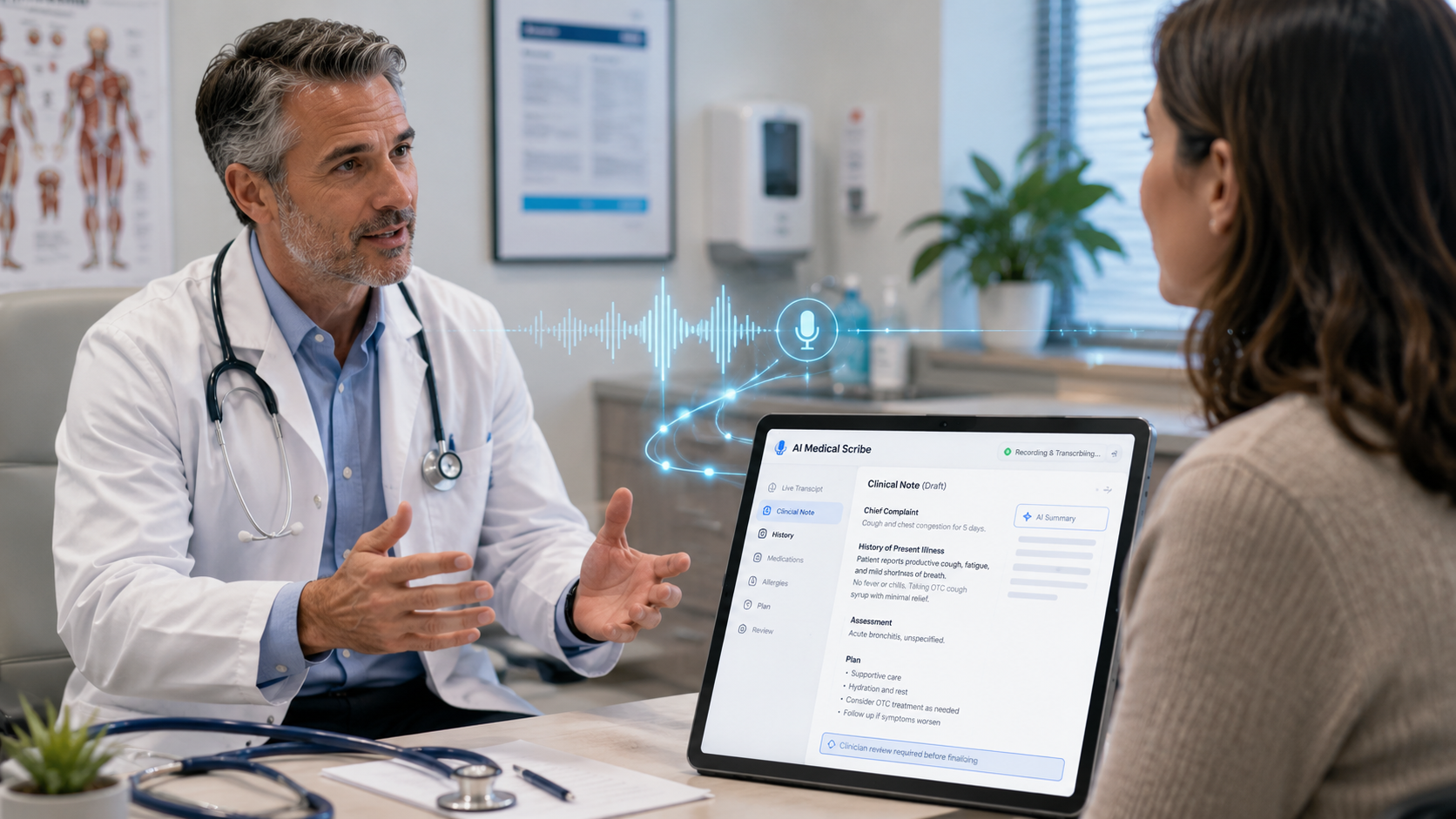
AI Medical Scribes: How Ambient AI Works, Benefits, Risks and Privacy in 2026
AI medical scribes can listen during clinical consultations and turn conversations into draft medical notes, letters and other documentation. This guide explains how ambient AI scr...
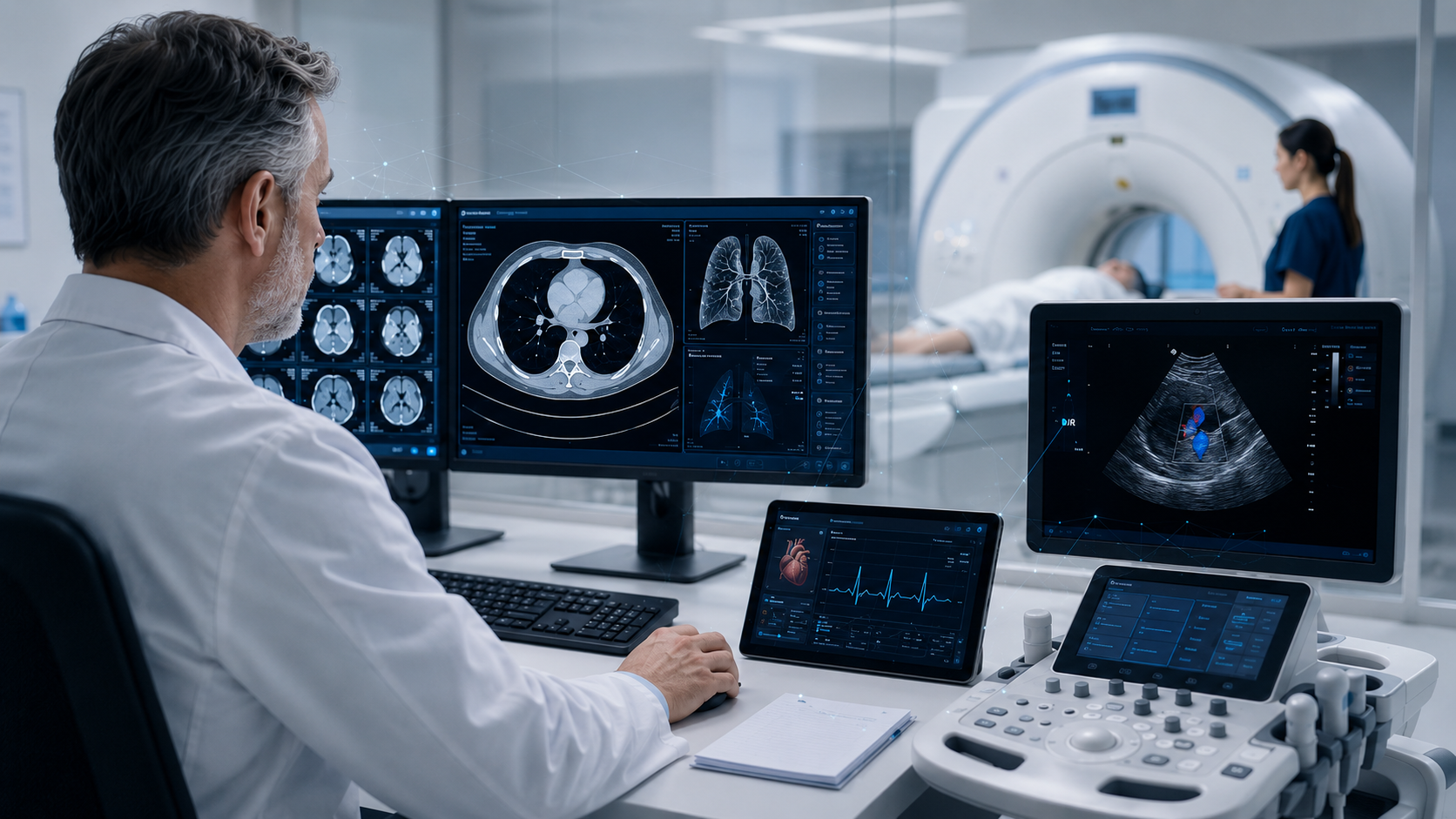
FDA AI-Enabled Medical Devices: 2026 List, Uses and Regulation
The FDA maintains a growing list of artificial intelligence-enabled medical devices authorized for marketing in the United States. This guide explains what the FDA list means, the...

AI in Healthcare: Uses, Benefits, Risks and Patient Questions (2026)
Artificial intelligence supports medical imaging, documentation, monitoring, research and hospital operations. This evidence-based 2026 guide explains its uses, potential benefits,...

AI in Medical Imaging: What Patients and Clinicians Should Know
Learn how artificial intelligence supports X-rays, CT, MRI, ultrasound and cancer screening, including its potential benefits, limitations, safety risks and FDA oversight.
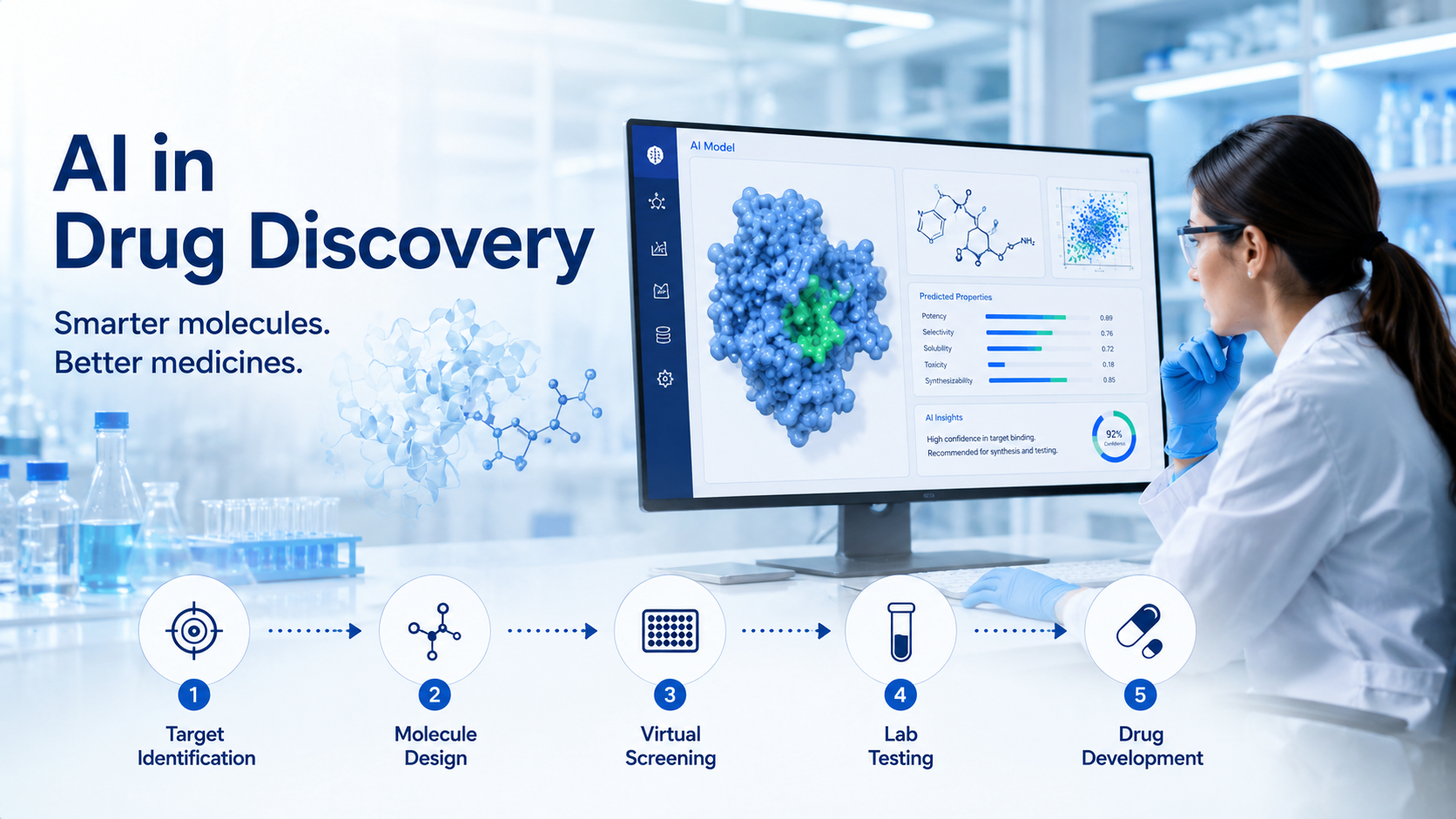
AI in Drug Discovery: How Artificial Intelligence Is Changing Drug Development in 2026
Artificial intelligence is being used to identify drug targets, screen compounds, design new molecules, predict toxicity and support clinical development. This guide explains how A...

AI Clinical Decision Support: How It Works, Uses, Risks and FDA Regulation in 2026
AI clinical decision support can help clinicians interpret patient information, estimate risk, consider diagnoses and review treatment options. This guide explains how AI-powered C...
Questions & Reader Feedback
Help improve this Atlas article
Ask a general question, comment on the article, suggest a correction, or propose a new topic. Nothing is published automatically. Every submission is reviewed by the Atlas editorial team first.
Was this article helpful?
0 helpful · 0 needs improvement