FDA AI-Enabled Medical Devices: 2026 List, Uses and Regulation
The FDA maintains a growing list of artificial intelligence-enabled medical devices authorized for marketing in the United States. This guide explains what the FDA list means, the difference between clearance, authorization and approval, selected 2026 devices, major clinical uses and how AI medical-device regulation is evolving.

Artificial intelligence is no longer limited to experimental healthcare software. It is already built into medical devices used for imaging, cardiovascular assessment, ultrasound, neurological care, surgical planning, physiological monitoring and other clinical tasks in the United States.
The U.S. Food and Drug Administration maintains a public list of AI-enabled medical devices that it has identified as authorized for marketing in the United States. The list is useful for clinicians, patients, researchers, health systems and developers who want to understand where AI is actually being used within regulated medical technology.
There is one important distinction to make at the outset. The phrase FDA-approved AI medical device is widely used in search results and news coverage, but it is not technically correct for every device on the FDA list. Depending on the regulatory pathway, a medical device may be cleared, authorized or approved.
This guide explains what the FDA list includes, what the different regulatory terms mean, which AI-enabled devices appear among the FDA's 2026 entries, why radiology remains the largest visible area of activity, and what clinicians and patients should look for beyond the words “uses AI.”
FDA AI medical devices in 2026: at a glance
92 entries currently carry 2026 FDA decision dates: On the FDA list reviewed for this guide, 92 entries have decision dates between January 5 and March 30, 2026.
Latest 2026 decision date currently visible on the list: March 30, 2026.
Radiology remains the dominant category: CT, MRI, ultrasound, mammography, image reconstruction, segmentation and other imaging technologies account for a large proportion of the entries.
AI is moving beyond imaging: Cardiovascular, neurology, surgery, orthopedics, gastroenterology, hematology, microbiology and other medical-device areas also appear.
Most entries should not simply be called “FDA approved”: Many AI-enabled devices reach the market through 510(k) clearance, while others use De Novo authorization or Premarket Approval.
The FDA list is not a real-time census: The agency explicitly states that the resource is not comprehensive and is updated periodically.
AI regulation is still evolving: In January 2026, the FDA issued updated final guidance on Clinical Decision Support Software. On August 18, 2026, it also released a discussion paper seeking feedback on the regulation of generative-AI-enabled medical devices.
Important: The figure of 92 refers to entries with 2026 decision dates that were visible in the FDA AI-Enabled Medical Devices List reviewed for this article. It should not be interpreted as a complete count of every AI-related medical-device authorization issued during 2026.
Current status of this FDA AI device guide
Evidence checked: August 21, 2026. The FDA list reviewed by Biomed Atlas currently shows AI-enabled medical-device entries with 2026 decision dates through March 30, 2026. The FDA describes the resource as non-comprehensive and says it is updated periodically, so both the number of listed 2026 entries and the latest visible decision date can change.
For that reason, this page treats the FDA list as a regularly updated regulatory reference rather than a fixed annual total. When the status of a particular product matters, the underlying FDA submission record should be checked directly.
What is an FDA AI-enabled medical device?
An AI-enabled medical device is a regulated medical device that incorporates artificial intelligence or machine-learning functionality as part of its intended medical purpose.
That description covers a much wider range of technology than the term “medical AI” sometimes suggests.
An AI-enabled device may, for example:
analyze CT, MRI, mammography, ultrasound or X-ray images;
identify or prioritize findings that may require clinical attention;
reconstruct medical images;
segment organs, tumors or other anatomical structures;
automate measurements;
process ECG or other physiological signals;
support surgical or procedural planning;
assist with monitoring;
help organize clinically relevant information;
perform a defined prediction, detection or classification task.
In some devices, the AI is visible to the clinician. A radiologist may see a highlighted region on an image or an automatically calculated measurement. In other systems, AI works more quietly in the background by improving image reconstruction, processing signals or supporting workflow before the information reaches the clinician.
That difference is important. “AI-enabled medical device” is not one uniform product category. It includes technologies with very different purposes, levels of clinical influence, evidence requirements and regulatory histories.
What is the FDA AI-Enabled Medical Devices List?
The FDA's Artificial Intelligence-Enabled Medical Devices List is a public resource intended to identify AI-enabled devices that the agency has recognized as authorized for marketing in the United States.
The FDA list includes information such as:
date of final decision;
FDA submission number;
device name;
company;
lead FDA review panel;
primary product code.
The submission number is particularly useful because it links a device to the relevant FDA regulatory database. Depending on the product and pathway, publicly available material may include a 510(k) summary, De Novo information, safety-and-effectiveness information or other regulatory documentation.
The FDA states that devices included in the list have met the applicable premarket requirements for their marketing pathway, including review relevant to safety and effectiveness for the device's intended use and technological characteristics.
However, the FDA also makes a qualification that should not be overlooked:
The AI-enabled medical-device list is not a comprehensive inventory of every AI-enabled medical device marketed in the United States.
How many FDA AI-enabled medical devices are there in 2026?
There is no single number that can be responsibly described as the total number of “FDA-approved AI devices in 2026.”
On the FDA list reviewed for this article, 92 entries have final decision dates in 2026, beginning on January 5 and extending through March 30, 2026.
That number is useful, but it needs context.
The FDA says its AI list is updated periodically rather than continuously. It also states that an AI-enabled device may be incorporated during a later update if relevant authorization information or a public decision summary was not available during an earlier data-collection period.
For that reason:
92 should be treated as the number of currently listed 2026 entries in the version reviewed here;
it should not be treated as a real-time count of every AI-related FDA decision made in 2026;
the newest date visible in the AI list should not automatically be interpreted as the newest AI-related device decision anywhere in the FDA system.
This distinction is particularly important for researchers, journalists and healthcare organizations using FDA data for market analysis.
Selected FDA AI-enabled medical devices listed in 2026
The examples below highlight selected devices appearing among the FDA's current 2026 entries. They show the range of clinical specialties and regulatory pathways represented and are not a complete list of all 92 currently listed 2026 entries.
Device | Company | Clinical area | FDA submission | Decision date |
|---|---|---|---|---|
AiORTA - Plan v2.0 | ViTAA Medical Solutions, Inc. | Radiology | K254207 | Mar 30, 2026 |
ECG-AI Pulmonary Hypertension 12-Lead Algorithm | Anumana, Inc. | Cardiovascular | K252360 | Mar 28, 2026 |
Spectral CT Verida Family | Philips Medical Systems Technologies, Ltd. | Radiology | K253649 | Mar 27, 2026 |
Butterfly Gestational Age Tool | Butterfly Network, Inc. | Radiology / Ultrasound | K252148 | Mar 27, 2026 |
Automated Aortic Stenosis Software (AutoAS) | GE Medical Systems Ultrasound & Primary Care Diagnostics, LLC | Radiology / Cardiovascular imaging | K254161 | Mar 27, 2026 |
Stealth AXiS Cranial clinical application | Medtronic Navigation, Inc. | Neurology | K253379 | Mar 26, 2026 |
Lunit INSIGHT DBT v1.2 | Lunit, Inc. | Radiology | K253796 | Mar 26, 2026 |
Tyto Insights for Eardrum Bulging Detection | Tyto Care, Ltd. | Ear, Nose & Throat | DEN250014 | Mar 17, 2026 |
Deep Capsule | Digestaid - Artificial Intelligence Development SA | Gastroenterology-Urology | K250655 | Mar 12, 2026 |
Onera SleepMap | Onera B.V. | Neurology | K253668 | Mar 8, 2026 |
EarliPoint Assessment | EarliTec Diagnostics | Neurology | K253442 | Mar 5, 2026 |
Claire OCT System | Perimeter Medical Imaging AI, Inc. | General and Plastic Surgery | P250008 | Mar 3, 2026 |
Delivery Date AI | Ultrasound AI | Radiology | DEN250007 | Feb 11, 2026 |
SafeBeat Rx App | SafeBeat Rx, Inc. | Cardiovascular | K251218 | Feb 6, 2026 |
Vital Signs | Oxehealth Limited | Cardiovascular | K251200 | Feb 2, 2026 |
RevealAI-Lung | Precision Medical Ventures, Inc. / RevealDx | Radiology | K251769 | Jan 30, 2026 |
BodyGuardian Remote Monitoring System v3.0 | Boston Scientific Cardiac Diagnostic Technologies, Inc. | Cardiovascular | K243349 | Jan 23, 2026 |
AI-Rad Companion Brain MR | Siemens Healthcare GmbH | Radiology | K253057 | Jan 22, 2026 |
Precision AI Surgical Planning System | Precision AI Pty, Ltd. | Orthopedic | K251558 | Jan 12, 2026 |
Corvair Monza | AliveCor, Inc. | Cardiovascular | K252589 | Jan 9, 2026 |
This is a selected reference table, not the complete FDA list. The entries were checked on August 21, 2026. Because the FDA updates its AI-enabled medical-device resource periodically, current regulatory information should be confirmed using the submission record for the individual device.
What types of AI medical devices are appearing on the FDA list?
The 2026 entries show that medical AI is becoming more diverse, even though imaging still dominates the visible landscape.
Radiology and medical imaging
Radiology remains the most prominent area for FDA-listed AI devices. Current entries involve technologies used with CT, MRI, mammography, ultrasound, nuclear medicine, radiation-treatment planning and other image-based workflows.
AI may be used for tasks such as:
image reconstruction;
segmentation;
detection or triage;
automated measurements;
anatomical analysis;
image-quality improvement;
treatment planning;
clinical workflow support.
Cardiovascular devices
The FDA list also shows that cardiovascular AI is not limited to cardiac imaging.
Some technologies analyze ECG data or other physiological signals, while others support remote monitoring, cardiovascular measurements or clinical assessment.
The ECG-AI Pulmonary Hypertension 12-Lead Algorithm is a useful example because the underlying clinical input is an electrocardiographic signal rather than a conventional CT or MRI image.
Ultrasound
Ultrasound is another rapidly developing area. AI may assist with image acquisition, automated measurements, image interpretation or specific clinical calculations.
The Butterfly Gestational Age Tool and other ultrasound-related systems appearing in the FDA list illustrate how AI is becoming part of devices used much closer to the point of care.
Neurology
Neurological applications represented in the 2026 entries include technologies associated with imaging, procedural navigation, assessment and monitoring.
Examples include Stealth AXiS Cranial, EarliPoint Assessment, Onera SleepMap and other systems reviewed under neurological or related device categories.
Surgery and procedural planning
AI-enabled medical-device technology is also extending into surgical and procedural settings.
Applications may support anatomical planning, navigation, segmentation, image interpretation or other defined functions used before or during a procedure.
Other clinical areas
The FDA's 2026 entries also include devices reviewed in areas such as:
gastroenterology-urology;
orthopedics;
hematology;
microbiology;
ear, nose and throat;
general hospital devices;
general and plastic surgery.
This diversity matters because the future of regulated medical AI is unlikely to be defined by one technology such as image classification. AI is increasingly being incorporated into the broader medical-device ecosystem.
Why are so many FDA AI medical devices related to radiology?
Radiology was a natural early environment for medical AI because the information clinicians use is already highly digital.
CT, MRI, mammography, ultrasound and X-ray systems generate large volumes of structured image data. Many radiology tasks also involve pattern recognition, reconstruction, segmentation and measurement—problems that can be well suited to machine-learning approaches.
Another practical factor is workflow. Imaging departments routinely handle large numbers of studies, making tools that can prioritize, measure, reconstruct or organize information potentially valuable even when the AI does not make an independent diagnosis.
Peer-reviewed research examining FDA-authorized AI medical devices has likewise found a strong concentration of image-based applications.
That concentration should not be mistaken for a permanent boundary around medical AI. The FDA's 2026 entries show growing activity involving ECG data, neurological assessment, remote monitoring, procedural systems and other types of medical information.
For more background, see AI in Medical Imaging: Uses, Benefits, Risks and FDA Oversight.
Are all devices on the FDA AI list “FDA approved”?
No. This is one of the most important terminology issues in medical-device reporting.
Several different regulatory pathways appear in the FDA's AI-enabled device list.
FDA pathway | Common terminology | Typical submission prefix | What the pathway generally does |
|---|---|---|---|
510(k) | FDA cleared | K | Usually evaluates whether a device is substantially equivalent to an appropriate legally marketed predicate. |
De Novo | FDA authorized | DEN | Provides a pathway for certain novel low- to moderate-risk devices when there is no suitable predicate. |
Premarket Approval (PMA) | FDA approved | P | Generally applies to higher-risk Class III devices and involves the FDA's most stringent device marketing application. |
510(k): FDA cleared
Many moderate-risk medical devices reach the U.S. market through the 510(k) pathway.
In a 510(k) review, the FDA evaluates whether the device is substantially equivalent to an appropriate legally marketed predicate device.
When the process is completed successfully, the usual terminology is FDA cleared.
A submission number beginning with K, such as K254207, generally identifies a 510(k) submission.
De Novo: FDA authorized
The De Novo pathway provides a route for certain novel low- to moderate-risk devices for which there is no suitable legally marketed predicate.
A successful De Novo request results in classification of the new device type and authorization to market the device.
Submission numbers beginning with DEN identify De Novo requests. Two examples appearing in the FDA's current 2026 AI list are Tyto Insights for Eardrum Bulging Detection and Delivery Date AI.
Premarket Approval: FDA approved
Premarket Approval, or PMA, is generally associated with higher-risk Class III medical devices and is the FDA's most stringent device marketing application.
For a device successfully reviewed through PMA, FDA approved is the appropriate wording.
The Claire OCT System, with submission number P250008, provides a 2026 example showing that AI-enabled devices do not all travel through the same regulatory pathway.
Why Biomed Atlas uses the term “FDA-authorized AI-enabled medical devices”
When discussing the FDA list as a whole, FDA-authorized is generally more accurate than describing every entry as FDA approved.
The broader wording allows for the different pathways represented in the dataset while avoiding the common mistake of treating clearance, De Novo authorization and PMA approval as interchangeable terms.
Searchers may still use phrases such as “FDA approved AI devices,” but the underlying regulatory record should always determine the terminology used for an individual product.
How does the FDA identify devices for the AI list?
The FDA explains that the list is built primarily by identifying AI-related terminology in publicly available marketing-authorization summaries and device classifications.
This creates a useful transparency resource, but it also explains why the list should not be treated as a complete census of every AI-enabled medical device on the U.S. market.
How often is the FDA AI-enabled medical-device list updated?
The FDA does not describe the AI-enabled medical-device list as a continuously updated, real-time database. The agency says the resource is updated periodically.
That timing matters when someone is trying to identify the newest device or count authorizations. A device may already have received FDA marketing authorization but appear on the AI list during a later update if the relevant public decision information was not available during an earlier data-collection period.
For researchers, clinicians and journalists, the practical takeaway is simple: use the list to discover and compare AI-enabled devices, but use the underlying FDA submission record when the exact regulatory status, intended use or decision date of an individual product matters.
Does FDA authorization mean an AI device is better than a doctor?
No.
FDA authorization concerns a particular medical device, its intended use and the regulatory requirements applicable to that product. It does not amount to a general conclusion that artificial intelligence performs better than a physician, radiologist, cardiologist or other healthcare professional.
The role of AI varies considerably from one device to another.
One product may help reconstruct an MRI scan. Another may analyze an ECG. Another may flag an image for closer review. A surgical system may assist with navigation or planning.
Those are very different clinical functions.
Instead of asking only whether a device “uses AI,” the more useful question is:
What exactly has this device been authorized to do, for which patients, and under what conditions?
What should you check for an individual AI medical device?
The FDA AI list is an excellent starting point, but an important clinical, research, procurement or investment decision should not rely on the list entry alone.
For an individual device, consider checking:
the exact device name;
manufacturer;
FDA submission number;
regulatory pathway;
date of the FDA decision;
intended use;
target patient population;
type of data used by the AI;
available performance evidence;
clinical study population;
limitations and warnings;
required level of professional oversight;
how the output is intended to fit into clinical workflow;
whether the software has undergone subsequent modifications.
The FDA submission number is often the most useful bridge between a broad AI-device list and the regulatory record for the individual product.
Clinical performance matters beyond regulatory status
An FDA marketing authorization is an important regulatory milestone, but it does not answer every question a hospital or clinician may have before adopting an AI-enabled device.
Healthcare organizations may also need to examine whether the available evidence reflects the population in which the product will actually be used.
Relevant questions include:
How large was the validation population?
Was the device evaluated at one center or across multiple sites?
Were different scanner types, clinical settings or patient populations represented?
How does performance change with disease prevalence?
What are the consequences of false positives and false negatives?
How is performance monitored after deployment?
How are software updates controlled?
This is particularly important for AI because model performance may depend on the characteristics of the data on which a system was developed and evaluated.
Can an AI medical device change after FDA authorization?
Yes, but regulated medical-device software cannot necessarily be updated in the same way as ordinary consumer software.
This question is especially important for machine-learning systems because developers may want to refine models after a device reaches clinical use.
The FDA has issued final guidance addressing predetermined change control plans, commonly called PCCPs, for AI-enabled device software functions.
A PCCP can describe planned future modifications to an AI-enabled device, the methods that will be used to develop, validate and implement those changes, and an assessment of their expected impact.
The aim is not to allow uncontrolled model changes. It is to create a regulatory framework in which certain anticipated changes can be considered in advance while maintaining reasonable assurance of device safety and effectiveness.
What is a predetermined change control plan?
A predetermined change control plan sets out specific modifications a manufacturer expects may be made to an AI-enabled medical device after authorization and explains how those modifications will be developed and evaluated.
The FDA's final guidance recommends that a PCCP address:
the planned device modifications;
the methodology used to develop, validate and implement them;
an assessment of how the modifications may affect the device.
The FDA reviews the proposed PCCP as part of the relevant marketing submission.
This approach is significant because AI-enabled devices may evolve more rapidly than traditional medical hardware.
The FDA has also worked with Health Canada and the UK's Medicines and Healthcare products Regulatory Agency on guiding principles for change-control plans involving machine-learning-enabled medical devices.
What changed for clinical decision-support software in 2026?
Clinical decision support is another area where the word “AI” can create regulatory confusion.
In January 2026, the FDA issued updated final guidance on Clinical Decision Support Software.
The guidance matters because not every healthcare software function falls within the legal definition of a medical device.
Under the framework discussed by the FDA, certain clinical decision-support functions may meet statutory criteria for exclusion from the device definition, while other software functions remain regulated as medical devices.
That means two pieces of healthcare software can both use advanced algorithms while having very different regulatory status.
For example, software that organizes or displays information so that a healthcare professional can independently review the basis of a recommendation raises different regulatory questions from software intended to perform a regulated diagnostic or treatment function.
This distinction is becoming increasingly important as AI moves into clinical software used outside traditional imaging systems.
What is happening with generative AI-enabled medical devices?
Generative AI introduces regulatory questions that are different from those associated with many traditional machine-learning medical devices.
A conventional algorithm may perform a narrowly defined task such as segmentation or classification. A generative model may produce variable outputs influenced by prompts, context, model architecture and other inputs.
On August 18, 2026, the FDA released a discussion paper titled Considerations for the Regulation of Generative AI-Enabled Medical Devices.
The agency is seeking stakeholder feedback on issues including:
risk assessment;
premarket evaluation;
postmarket monitoring;
other regulatory considerations specific to generative-AI-enabled medical devices.
This is an important development, but the terminology matters:
The August 18, 2026 publication is a discussion paper and request for feedback. It is not final FDA guidance and should not be described as a new binding regulatory framework.
For more background, see Generative AI in Healthcare: Uses, Risks and Regulation in 2026.
FDA AI medical devices vs general AI health apps
Not every health-related application that uses artificial intelligence is an FDA-regulated medical device.
The distinction depends primarily on what the software is intended to do. A general wellness tool or consumer application that offers broad educational information raises a different regulatory question from software intended to detect disease, analyze patient-specific medical information or perform another regulated medical-device function.
This is why labels such as “medical AI,” “clinical AI” or “AI health assistant” do not establish FDA authorization on their own. The relevant question is whether the specific product and intended use fall within the medical-device framework and, if so, which regulatory pathway applies.
Are ChatGPT and general-purpose AI chatbots FDA-approved medical devices?
Not simply because they can answer medical questions.
A software product's regulatory status depends on factors including its intended use and the function it performs.
A general-purpose conversational AI system should therefore not automatically be described as an FDA-authorized medical device merely because users can ask it questions about health or medicine.
This distinction matters for patients. A health-related response produced by a general-purpose AI chatbot should not be interpreted as having undergone FDA medical-device review unless a specific regulated product and intended use have actually received the relevant authorization.
For a broader discussion, see Artificial Intelligence in Healthcare: Uses, Benefits and Risks.
Will the FDA identify devices that use large language models?
The FDA says it plans to explore methods for identifying and tagging medical devices that incorporate foundation models, including large language models and multimodal architectures.
This could become increasingly useful as medical AI expands beyond conventional image processing and signal analysis.
Future medical-device software may combine text, imaging, laboratory information, physiological signals and other forms of clinical data within a single model or workflow.
Clearer identification of foundation-model functionality could help clinicians, patients, researchers and developers distinguish newer generative or multimodal systems from earlier generations of machine-learning medical devices.
What should clinicians consider beyond FDA status?
Regulatory status is important, but it is only one part of responsible clinical adoption.
Before deploying an AI-enabled medical device, a healthcare organization may also need to consider:
the precise intended use;
clinical evidence;
the population in which the device was evaluated;
performance across relevant demographic and clinical groups;
false-positive and false-negative consequences;
workflow integration;
human oversight;
automation bias;
cybersecurity;
data governance;
software-update policies;
post-deployment performance monitoring;
what happens when the AI output conflicts with clinical judgment.
An algorithm that performs well in a development or validation dataset may not necessarily perform identically in every hospital, patient population or workflow.
For that reason, clinical validation and ongoing oversight remain important even after a product has completed the applicable FDA premarket pathway.
What should patients know about AI-enabled medical devices?
Patients do not need to understand neural-network architecture or machine-learning mathematics to ask useful questions about AI in their care.
If an AI-enabled device plays an important role in a clinical decision, reasonable questions may include:
What is the AI being used to do?
Is it helping with detection, diagnosis, measurement, monitoring, imaging or workflow?
Does a healthcare professional review the AI result?
Is the product FDA authorized for this particular use?
What information does the device analyze?
What happens if the AI output and the clinician's assessment disagree?
Are there known limitations?
How is patient information handled?
The fact that a device contains AI does not by itself tell a patient whether the device is suitable for them.
Its intended use, clinical evidence, limitations and role within professional medical care matter far more than the AI label.
How can you verify an AI medical device with the FDA?
If you encounter a claim that a product is “FDA-approved AI,” verify the underlying record rather than relying on the phrase itself.
A practical approach is:
Confirm the exact product name.
Confirm the manufacturer.
Locate the product in the FDA AI-Enabled Medical Devices List when available.
Record the FDA submission number.
Open the corresponding FDA database entry.
Identify whether the device was cleared through 510(k), authorized through De Novo, approved through PMA or reviewed through another applicable route.
Read the publicly available summary for the intended use, performance information and limitations.
This process is more informative than relying on a manufacturer's marketing page, a news headline or a third-party list.
Why the FDA AI-device list matters
The importance of the FDA list goes beyond counting products.
It provides a view of how AI is moving from research environments into regulated clinical technology.
The pattern is revealing.
Medical AI is not developing as a single replacement for clinicians. Instead, it is being incorporated into hundreds of narrowly defined device functions: reconstructing an image, analyzing an ECG, assisting ultrasound measurements, identifying findings, supporting navigation, processing physiological information or helping clinicians work through increasingly complex datasets.
That is likely to remain one of the defining characteristics of medical AI: much of its clinical impact will come through individual regulated tools embedded inside existing healthcare workflows rather than through one universal “AI doctor.”
Key takeaways
The FDA maintains a public list of AI-enabled medical devices it has identified as authorized for marketing in the United States.
On the current FDA list reviewed for this article, 92 entries have 2026 decision dates between January 5 and March 30.
The figure of 92 is not a complete count of every AI-device authorization made during 2026 because the FDA says its list is non-comprehensive and periodically updated.
Not every device on the list is technically “FDA approved.” Many are cleared through 510(k), while De Novo and PMA pathways are also represented.
Radiology and medical imaging remain the most visible areas of FDA-listed AI-device activity.
Cardiovascular, neurological, surgical, orthopedic, gastrointestinal, monitoring and other applications show that regulated AI is expanding well beyond imaging.
FDA authorization applies to a defined device and intended use. It does not mean that AI is generally superior to healthcare professionals.
The regulatory record for an individual product is more informative than a generic claim that a device is “FDA approved.”
The FDA has established guidance for predetermined change control plans that can address certain planned modifications to AI-enabled medical devices.
Updated final Clinical Decision Support Software guidance was issued in January 2026.
On August 18, 2026, the FDA released a discussion paper seeking feedback on the regulation of generative-AI-enabled medical devices. It is a discussion paper, not final guidance.
Frequently asked questions
What is the FDA AI-Enabled Medical Devices List?
It is an FDA-maintained resource identifying AI-enabled medical devices that the agency has recognized as authorized for marketing in the United States. It includes the device name, company, submission number, decision date, lead review panel and primary product code. The FDA states that the list is not comprehensive.
How many FDA AI medical devices are listed for 2026?
In the FDA list reviewed by Biomed Atlas, 92 entries have final decision dates in 2026, ranging from January 5 through March 30, 2026. This should not be interpreted as a complete count for the entire year because the FDA list is periodically updated and is not a comprehensive inventory of all AI-enabled devices.
What is the newest 2026 AI medical device currently shown on the FDA list?
In the version of the FDA list reviewed for this article, AiORTA - Plan v2.0 has the latest visible 2026 decision date, March 30, 2026. Because the FDA list is updated periodically, this does not necessarily mean it is the latest AI-related medical-device decision made by the FDA.
Are most FDA AI medical devices related to radiology?
Radiology represents a large share of the FDA's AI-enabled medical-device list. CT, MRI, ultrasound, mammography and other image-based technologies are especially prominent. Cardiovascular medicine, neurology, surgery, monitoring and other specialties are also represented.
What is the difference between FDA clearance and FDA approval?
FDA clearance usually refers to successful review through the 510(k) pathway, where a device is evaluated for substantial equivalence to an appropriate legally marketed predicate. FDA approval generally refers to Premarket Approval, which is typically associated with higher-risk Class III devices.
What does De Novo authorization mean?
The De Novo pathway provides a route for certain novel low- to moderate-risk devices when there is no suitable legally marketed predicate. Successful De Novo classification authorizes the device for marketing and establishes a new device type.
Does FDA clearance mean an AI device is better than a doctor?
No. FDA clearance or other marketing authorization applies to a particular device and intended use. It is not a general conclusion that artificial intelligence performs better than physicians or other healthcare professionals.
Is ChatGPT an FDA-approved medical device?
A general-purpose AI chatbot should not automatically be considered an FDA-authorized medical device. Regulatory status depends on the intended use and function of a particular product.
Can FDA-authorized AI software be updated?
Yes, but changes to regulated medical-device software may require regulatory controls. FDA guidance on predetermined change control plans provides a framework for certain anticipated modifications to AI-enabled device software.
Is the FDA AI-device list updated in real time?
No. The FDA says it updates the list periodically. Some devices that have already received marketing authorization may appear during a subsequent update when the relevant public information becomes available.
Does the FDA regulate generative AI medical devices?
A generative-AI system that meets the definition of a medical device can fall within FDA medical-device regulation. On August 18, 2026, the FDA released a discussion paper seeking feedback on regulatory considerations specific to generative-AI-enabled medical devices. The document is not final guidance.
Where can I find the official FDA AI medical-device list?
The official list is published by the U.S. Food and Drug Administration through its medical-device and Digital Health resources. For an individual product, the underlying FDA submission record should be used to verify regulatory status.
Related Biomed Atlas guides
Artificial Intelligence in Healthcare: Uses, Benefits and Risks
AI in Medical Imaging: Uses, Benefits, Risks and FDA Oversight
Generative AI in Healthcare: Uses, Risks and Regulation in 2026
Sources and further reading
U.S. Food and Drug Administration — Artificial Intelligence-Enabled Medical Devices
U.S. Food and Drug Administration — Medical Device Safety and the 510(k) Clearance Process
U.S. Food and Drug Administration — Clinical Decision Support Software: Final Guidance
Biomedicines — Machine Learning-Enabled Medical Devices Authorized by the U.S. FDA in 2024
Evidence reviewed: August 21, 2026. The FDA updates its AI-enabled medical-device resources periodically. Counts and the latest listed decision date can therefore change. Regulatory status, intended use and supporting information for an individual product should be verified directly in the relevant FDA database.
Medical information notice
Atlas content is intended for education and general information. Seek advice from a qualified healthcare professional for personal symptoms, treatment decisions, or urgent medical concerns.
How this article is maintained
Atlas uses editorial review, evidence checks, visible update dates and a public correction route. Educational content does not replace professional medical advice.
Continue reading
Continue your recent reading
Pick up another medical or biomedical article you opened earlier on this device.
Continue exploring
More medical and biomedical reading
Continue with editorially selected and category-matched articles designed to help readers explore the subject in greater depth.

Generative AI in Healthcare: Uses, Risks and Regulation in 2026
Generative AI is moving into clinical documentation, patient communication, medical research and decision-support workflows. This guide explains how it is being used in healthcare,...
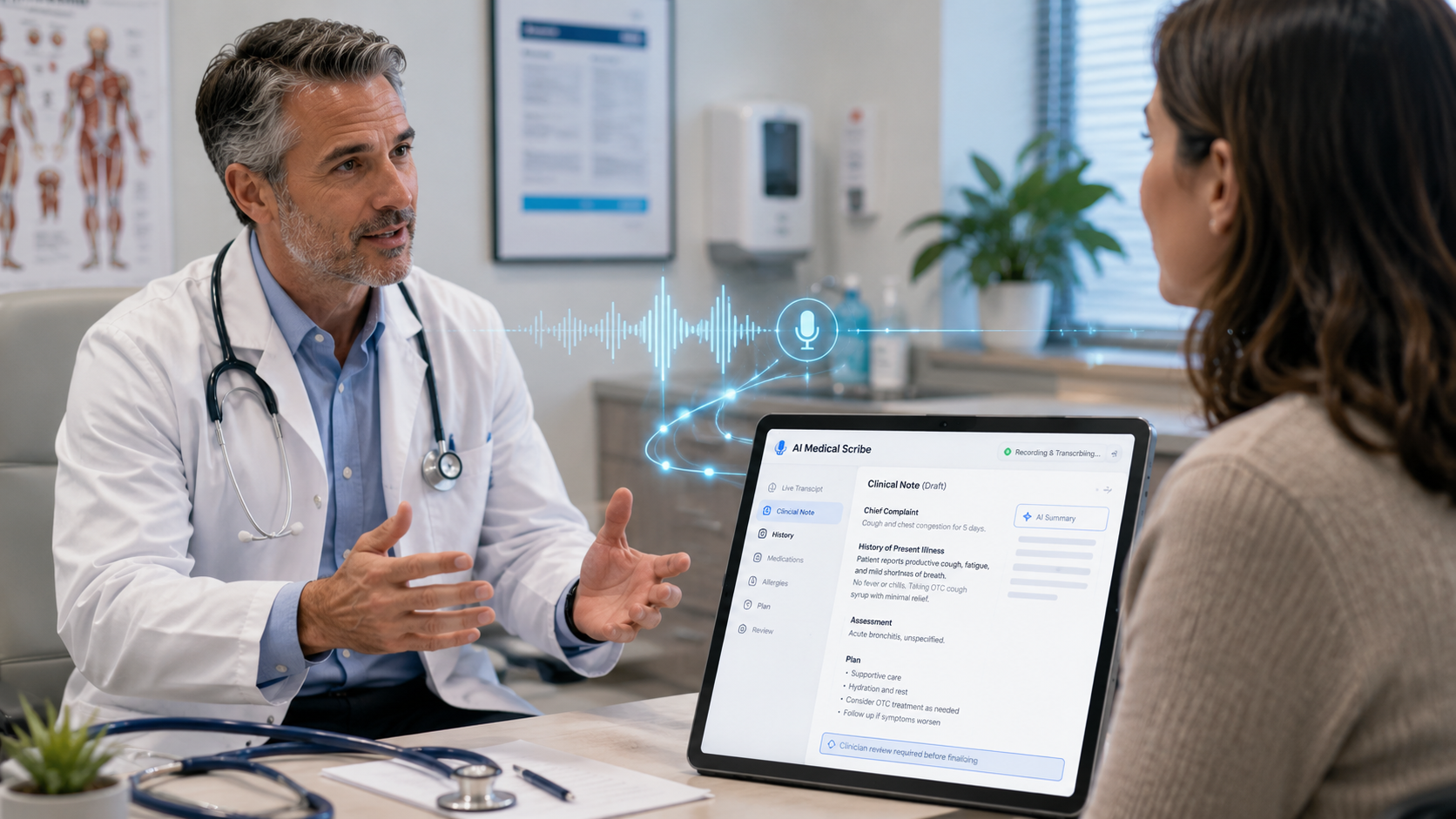
AI Medical Scribes: How Ambient AI Works, Benefits, Risks and Privacy in 2026
AI medical scribes can listen during clinical consultations and turn conversations into draft medical notes, letters and other documentation. This guide explains how ambient AI scr...

AI in Healthcare: Uses, Benefits, Risks and Patient Questions (2026)
Artificial intelligence supports medical imaging, documentation, monitoring, research and hospital operations. This evidence-based 2026 guide explains its uses, potential benefits,...

AI in Medical Imaging: What Patients and Clinicians Should Know
Learn how artificial intelligence supports X-rays, CT, MRI, ultrasound and cancer screening, including its potential benefits, limitations, safety risks and FDA oversight.

AI in Drug Discovery: How Artificial Intelligence Is Changing Drug Development in 2026
Artificial intelligence is being used to identify drug targets, screen compounds, design new molecules, predict toxicity and support clinical development. This guide explains how A...

AI Clinical Decision Support: How It Works, Uses, Risks and FDA Regulation in 2026
AI clinical decision support can help clinicians interpret patient information, estimate risk, consider diagnoses and review treatment options. This guide explains how AI-powered C...
Questions & Reader Feedback
Help improve this Atlas article
Ask a general question, comment on the article, suggest a correction, or propose a new topic. Nothing is published automatically. Every submission is reviewed by the Atlas editorial team first.
Was this article helpful?
0 helpful · 0 needs improvement