Agentic AI in Healthcare: How AI Agents Work, Uses, Risks and Regulation in 2026
Agentic AI can go beyond generating answers by planning steps, using tools and carrying out approved actions across healthcare workflows. This guide explains how healthcare AI agents work, current uses, emerging evidence, safety risks, human oversight and the evolving regulatory picture in 2026.
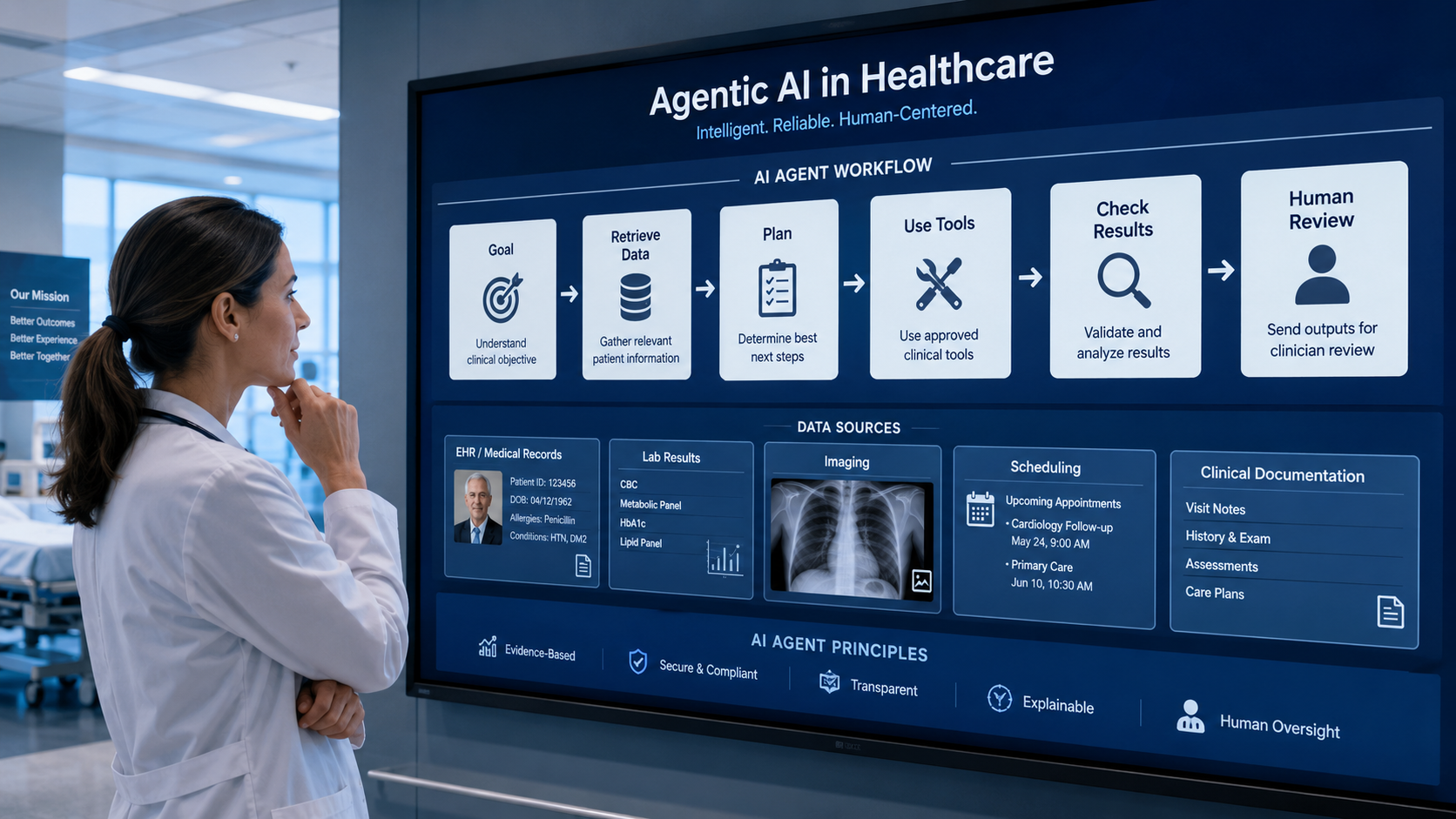
Agentic AI is becoming one of the most closely watched developments in healthcare artificial intelligence. Unlike a conventional chatbot that waits for a prompt and returns a response, an AI agent can be designed to work through a goal in several steps: retrieve information, choose tools, call other software, check intermediate results and carry out approved actions.
That extra ability makes agentic systems potentially useful for clinical and administrative workflows that are too complex for a single prediction or generated answer. It also changes the safety problem. An incorrect chatbot response is one error; an agent that acts on an incorrect assumption may carry that error into several downstream steps.
In 2026, the evidence base is growing quickly but remains immature. Peer-reviewed reviews describe applications in diagnostics, care management, radiology, rehabilitation and workflow support, while emphasizing that many systems are still being tested in controlled or exploratory settings rather than routine patient care.
The regulatory discussion is also moving quickly. In August 2026, the U.S. Food and Drug Administration explicitly included agentic AI systems among the issues raised in its discussion paper on generative-AI-enabled medical devices. The paper is exploratory, not final guidance.
This guide explains what agentic AI means in healthcare, how it differs from generative AI and ordinary automation, where AI agents may be useful, what the current evidence shows, and why human oversight, auditability and controlled permissions matter as systems become more autonomous.
Agentic AI in healthcare: 2026 at a glance
Question | Current answer |
|---|---|
What is agentic AI? | AI designed to pursue a defined goal through multiple steps, often using tools, external data, memory or other agents. |
How is it different from a chatbot? | A chatbot mainly generates a response. An agent can be designed to decide what step comes next and initiate approved actions. |
Where is it being explored? | Administrative workflows, clinical information retrieval, diagnostics, radiology, rehabilitation, research, drug development and longitudinal support. |
Is it already proven in routine clinical care? | No. Research is expanding, but much of the evidence remains exploratory, retrospective, simulated or benchmark-based. |
What are the main risks? | Error propagation, inappropriate actions, hallucinations, privacy problems, excessive permissions, poor auditability, automation bias and unclear accountability. |
What is happening with regulation? | The FDA's August 2026 GenAI medical-device discussion paper specifically raises considerations involving agentic AI, but it is not final guidance. |
What is agentic AI in healthcare?
Agentic AI refers to artificial-intelligence systems designed to work toward a goal rather than simply produce one output.
A healthcare agent might receive a task such as:
prepare a clinician for an upcoming complex appointment;
identify relevant information across a patient's record;
check whether required follow-up information is available;
organize supporting evidence;
prepare a draft action for professional approval;
or coordinate several specialized AI tools within a defined workflow.
The important word is defined. A safe healthcare agent should not be imagined as software with unlimited freedom to act. In realistic clinical environments, its tools, data access, permissions and escalation rules need boundaries.
What makes an AI system truly agentic?
The word agentic is increasingly used in healthcare technology, but not every AI system that performs several tasks should automatically be described as an autonomous agent.
Researchers generally associate agentic systems with some combination of goal-directed behavior, planning, tool use, access to external information, adaptation based on intermediate results, retained context or memory, action initiation and, in some architectures, collaboration with other agents.
There is still no universally accepted clinical definition. That matters because the label alone tells a reader very little about risk. A system that retrieves records and drafts a summary is very different from one that can modify a workflow, send a message or trigger a clinical action.
The more useful question is therefore not simply, “Is this agentic AI?” but what can this system access, decide and do without human approval?
AI agents, agentic AI and generative AI are not the same thing
The terminology is still developing, and researchers do not always use the terms in exactly the same way. A practical distinction is useful.
Technology | Main behavior | Healthcare example |
|---|---|---|
Traditional AI | Performs a relatively narrow prediction, classification or measurement task | Detecting a finding on a medical image |
Generative AI | Creates new content such as text, summaries or images | Drafting a consultation note |
AI agent | Uses a model together with tools or external systems to complete one or more steps toward a goal | Retrieving relevant records and preparing a structured pre-visit summary |
Agentic AI | Shows a higher degree of goal-directed planning, tool use, adaptation or action across multiple steps | Coordinating information retrieval, checks and approved follow-up tasks in a clinical workflow |
Multi-agent system | Uses several specialized agents that collaborate or divide work | Separate agents for imaging, laboratory data, medication review and workflow coordination |
Many agentic systems use large language models or other foundation models as a reasoning and communication layer. But an LLM alone is not automatically an agent. The defining issue is what the system is allowed to do with its output.
For background on the broader technology, see Generative AI in Healthcare: Uses, Risks and Regulation in 2026.
How does an AI agent work?
Different systems use different architectures, but a simplified healthcare workflow may look like this:
Goal: A user or system defines the task.
Context: The agent gathers permitted information relevant to that task.
Planning: It determines which steps or tools may be needed.
Tool use: It calls approved software, databases, calculators, retrieval systems or specialized models.
Intermediate checking: The system evaluates whether the result is sufficient or whether another step is required.
Action or recommendation: It produces an output or prepares an action.
Human review: For higher-risk healthcare tasks, a qualified professional reviews, approves, changes or rejects the result.
Audit trail: The organization should be able to determine what information, tools and actions were involved.
The difference between a useful clinical agent and an unsafe one often lies less in the sophistication of the underlying model than in the controls around these steps.
Why is agentic AI attracting attention in healthcare?
Healthcare is full of work that involves sequences rather than single questions.
A clinician preparing for a complex patient may need to review prior notes, laboratory results, imaging, medication changes, referrals and unresolved follow-up items. A research team may need to search literature, extract information, compare evidence and document the basis for a conclusion. A clinical-trial team may need to move information across several systems while maintaining an audit trail.
A conventional AI model can assist with one part of those tasks. An agentic system is intended to coordinate several parts.
That creates a potentially important productivity advantage: the unit of automation changes from one answer to part of a workflow.
How widely is agentic AI being used in healthcare in 2026?
Interest in agentic AI is rising faster than routine clinical deployment.
Healthcare organizations are clearly moving beyond isolated generative-AI experiments. In McKinsey's fourth-quarter 2025 survey of 150 U.S. healthcare leaders, half of respondents said their organizations had implemented generative AI, and the survey found growing interest in agentic and multi-agent workflows.
That finding should not be read as evidence that half of U.S. hospitals are using autonomous clinical agents. The survey covered payers, clinical-care organizations, and healthcare services and technology companies, and it measured generative-AI implementation more broadly.
The practical picture in 2026 is more cautious: generative AI is becoming established in documentation and productivity workflows, while agentic systems are earlier in their clinical development. The most credible near-term uses are those in which actions are tightly bounded, auditable and subject to human review when the consequences of an error could affect patient care.
Where could agentic AI be used in healthcare?
1. Pre-visit clinical preparation
An agent could gather recent results, identify changes in medications, summarize previous specialist recommendations and flag unresolved follow-up items before a clinician sees the patient.
The safest version of this workflow would make the underlying sources easy to inspect rather than presenting a polished summary with no traceable evidence.
2. Clinical documentation workflows
Ambient AI scribes already show how generative AI can turn a clinical conversation into draft documentation. Agentic systems could extend that workflow by checking whether required fields are complete, preparing follow-up material or routing approved outputs to the appropriate system.
That additional automation increases both usefulness and risk. Documentation assistance should not silently become diagnosis, ordering or treatment automation simply because the underlying model is capable of generating those suggestions.
See AI Medical Scribes: How Ambient AI Works, Benefits, Risks and Privacy in 2026.
3. Clinical information retrieval
An agent may help answer a complex clinical information question by searching approved sources, retrieving relevant guidance and organizing evidence for professional review.
For high-stakes use, provenance matters. The user should be able to see which sources support an important statement and whether the source is current.
4. Radiology and medical imaging workflows
Agentic systems are being discussed as a way to coordinate multiple imaging-related tasks: retrieving prior studies, selecting specialized analysis tools, comparing findings, preparing structured information and helping manage follow-up workflows.
The clinical risk varies enormously depending on whether the agent is organizing information or independently influencing diagnosis or treatment.
See AI in Medical Imaging: Uses, Benefits, Risks and FDA Oversight.
5. Care coordination and longitudinal support
Longitudinal healthcare requires continuity over time rather than one isolated interaction. Researchers are exploring health agents that could help track goals, symptoms, follow-up needs and changing context across repeated interactions.
This area is especially demanding because a system that operates over weeks or months must manage changing information, uncertainty, user preferences and accountability.
6. Research and scientific discovery
Agentic systems can coordinate literature search, data analysis, tool use and iterative hypothesis generation. In 2026, Nature Medicine published work describing an agentic framework for scientific discovery in cancer pathology, illustrating how agents may support research workflows rather than only patient-facing applications.
Scientific autonomy should not be confused with proof. Agent-generated hypotheses and analyses still need appropriate validation.
7. Drug development and clinical trials
Pharmaceutical and research workflows contain many structured, multi-step processes involving protocol information, safety data, clinical data management and regulatory documentation. Agentic tools are being developed to assist some of these workflows.
These applications may be attractive because they can produce measurable operational benefits without giving an AI system direct authority over bedside clinical decisions.
8. Administrative operations
Administrative workflows may be among the earliest places where agents can provide practical value with comparatively lower clinical risk.
Examples include:
routing routine requests;
collecting missing administrative information;
preparing correspondence;
organizing documents;
checking workflow status;
and escalating exceptions to a human.
What does the 2026 evidence show?
The evidence is promising enough to justify serious attention, but not mature enough to support broad claims of autonomous clinical readiness.
A March 2026 scoping review in npj Digital Medicine identified seven eligible studies of agentic AI in healthcare spanning areas such as emergency medicine, oncology, radiology and rehabilitation. The authors reported promising performance in tasks including diagnosis, treatment planning, alerts, coaching and workflow optimization, but emphasized that most studies were exploratory and that only one involved a patient trial.
A July 2026 evidence map in npj Digital Medicine similarly described early deployments as being concentrated in administrative workflows while agentic applications expand across the clinical journey. The authors highlighted governance, auditability and clinician oversight as important conditions for responsible implementation.
A broader 2026 survey in the Journal of Biomedical Informatics reviewed a much larger research landscape and concluded that healthcare agents show substantial potential, while real-world translation still depends on reliability, privacy, governance and operational integration.
More recently, an August 2026 npj Digital Medicine scoping review examined 37 peer-reviewed studies of multimodal healthcare AI agents. The studies covered clinical decision support, documentation and report generation, monitoring and health management, and medical education. The review adds useful evidence that healthcare agents are becoming technically more capable, but it also reinforces the gap between promising prototypes and proven large-scale clinical deployment.
The pattern is important: there is a great deal of research activity, but research volume should not be mistaken for clinical validation.
What are the potential benefits of agentic AI?
Less fragmented work
Many healthcare processes require clinicians or staff to move manually between several systems. An agent can potentially coordinate some of that work while keeping the user focused on the clinical goal.
More complete information gathering
A well-designed agent can be instructed to check several permitted sources rather than relying on whichever record happens to be open first.
Faster routine workflows
Repeated administrative or information-management steps may be suitable for controlled automation.
Better use of specialized AI tools
An agent can act as an orchestrator, selecting a specialized model or software tool when needed rather than asking one general model to do everything.
Continuous follow-up
Some health tasks extend over time. Agentic systems may eventually help maintain continuity across repeated interactions, although this area requires particularly careful oversight.
Why agentic AI creates different risks from ordinary generative AI
A generative model can be wrong. An agent can be wrong and then act on the error.
That distinction is central to healthcare safety.
Error propagation
If the first step in a multi-step workflow is incorrect, later steps may build on the same error.
For example, an agent that incorrectly interprets a medication as active might use that assumption when preparing a summary, checking interactions and drafting follow-up information.
Excessive permissions
An agent should have access only to the systems and actions required for its job.
Giving broad permissions to a model-based system creates unnecessary risk. Reading a record, drafting an order and submitting an order are three different levels of authority.
Hallucinated tool use or reasoning
An agent may produce an incorrect interpretation of what a tool returned or select an inappropriate tool for the problem.
Automation bias
As systems complete more steps automatically, users may become less likely to inspect intermediate decisions.
Loss of diagnostic uncertainty
Healthcare often involves uncertainty. An agent may unintentionally turn a tentative hypothesis into a definite statement as information moves through successive steps.
Privacy and security
An agent that connects to several systems may have access to more sensitive information than a standalone chatbot.
Organizations need to understand what data the agent can access, what it sends to external services, how actions are logged and how credentials are protected.
Unclear accountability
If an agent retrieves information, chooses a tool, generates a recommendation and initiates a downstream workflow, responsibility needs to remain clear.
“The AI did it” is not an adequate governance model.
Levels of AI-agent autonomy in healthcare
It is useful to think about healthcare agents in terms of how much authority they receive, because risk changes as a system moves from helping a professional to acting on a patient's behalf.
Level | Typical behavior | Example | Human role |
|---|---|---|---|
Assistive | Retrieves or organizes information | Prepares relevant records before an appointment | The clinician makes the decision and performs the action |
Advisory | Produces a recommendation or draft | Drafts a follow-up plan for review | The clinician accepts, changes or rejects the output |
Supervised action | Prepares or performs an approved workflow step | Sends a patient message after an authorized review step | Human approval is required at a defined checkpoint |
Bounded autonomy | Performs predefined actions within strict limits | Completes a low-risk administrative workflow and escalates exceptions | Humans monitor exceptions, outcomes and system performance |
High clinical autonomy | Makes consequential patient-specific decisions with minimal intervention | Autonomous diagnosis or treatment action | This is not an established routine model of clinical deployment |
This is a practical Biomed Atlas explanatory framework, not an official FDA classification. The appropriate level of autonomy depends on the consequence of an error, the evidence supporting the system, the intended use and the controls around deployment.
Human in the loop is not one single control
The phrase human in the loop is often used as though it automatically makes an AI system safe. It does not.
Human oversight can occur at several points:
before the agent begins;
before it accesses sensitive information;
before it uses a higher-risk tool;
before a recommendation reaches the medical record;
before an order or message is sent;
or after the workflow for monitoring and audit.
The correct control depends on the consequence of a mistake.
An agent preparing a draft meeting summary does not need the same approval architecture as an agent preparing a patient-specific treatment action.
What should an audit trail show?
Auditability becomes more important as an AI system gains more autonomy.
For a clinically important workflow, an organization may need to know:
what goal the agent received;
which patient information it accessed;
which external sources it retrieved;
which tools or models it called;
what intermediate outputs were produced;
what action it proposed or initiated;
what the human reviewer changed;
and which software/model version was involved.
A system that cannot explain its operational history may be difficult to investigate when something goes wrong.
Agentic AI vs ordinary healthcare automation
Feature | Traditional workflow automation | Agentic AI |
|---|---|---|
Logic | Usually follows predefined rules | May dynamically choose steps based on context |
Tool selection | Normally fixed in advance | May choose among permitted tools |
Output variability | Usually predictable | Can vary because model reasoning is probabilistic |
Error behavior | Often easier to reproduce | May be harder to reproduce and can propagate across steps |
Best use | Stable, repetitive processes | More flexible workflows that require context, planning or adaptation |
Governance need | Rules, testing and change control | Rules plus model evaluation, permissions, auditability, escalation and human oversight |
Agentic AI does not make conventional automation obsolete. If a workflow can be performed safely with deterministic rules, a more autonomous system may add complexity without adding enough value.
What is multi-agent AI in healthcare?
A multi-agent system divides work among several specialized agents.
One agent might retrieve medical literature, another analyze structured laboratory data, another summarize relevant imaging information and another coordinate the final workflow.
This architecture may allow specialization, but it also creates more interactions to validate. Errors can arise not only within an individual agent but in the way agents communicate with one another.
More agents do not automatically mean better performance.
What is the FDA saying about agentic AI in 2026?
On August 18, 2026, the FDA released a discussion paper on the regulation of generative-AI-enabled medical devices.
The document discusses several emerging issues, including foundation models and agentic AI systems. The FDA is seeking feedback as it considers how existing medical-device regulation may need to account for technologies that can behave differently from traditional fixed-function software.
The agency is also exploring possible approaches to risk assessment, premarket competency evaluation and risk-proportionate postmarket monitoring.
This is not final FDA guidance. The paper is intended to support discussion and gather stakeholder input. The current public-comment deadline is October 19, 2026 under docket FDA-2026-N-7874.
For a detailed explanation of AI medical-device pathways, see FDA AI-Enabled Medical Devices: 2026 List, Uses and Regulation.
When might an AI agent become a medical device?
There is no rule that says every AI agent used by a healthcare organization is automatically a medical device.
The regulatory question depends on the product's intended use and function.
An agent that organizes administrative correspondence raises a different question from an agent intended to analyze patient data and make a diagnosis or treatment recommendation.
As an agent becomes more influential in patient-specific clinical decisions, medical-device regulation, clinical validation and professional oversight become increasingly important.
Should an autonomous AI agent be allowed to place medical orders?
This is a much higher-risk use than retrieving information or preparing a draft.
Before allowing an agent to initiate a consequential clinical action, an organization would need strong evidence, tightly controlled permissions, reliable identity and access management, clear approval rules, auditability, failure recovery and a well-defined accountability model.
In many current deployments, the safer design is to let the agent prepare an action while a qualified professional decides whether to execute it.
What should healthcare organizations evaluate before deploying an AI agent?
The evaluation should begin with the workflow, not with the model.
Purpose: What exact job is the agent supposed to perform?
Clinical consequence: What could happen if it is wrong?
Autonomy: What is it allowed to do without approval?
Permissions: Which records, tools and systems can it access?
Evidence: Has this workflow been evaluated in a relevant real-world population?
Source traceability: Can important claims be traced to their origin?
Human review: Where is professional approval required?
Escalation: What happens when the system is uncertain or encounters an exception?
Auditability: Can the organization reconstruct what the agent did?
Security: How are credentials, data and external tool calls protected?
Updates: How are changes to models, prompts, tools and workflows controlled?
Monitoring: How will errors and near misses be detected after deployment?
Accountability: Who remains responsible for the final clinical action?
What should clinicians know?
Clinicians do not need to understand every detail of an agent's software architecture, but they do need to understand its role in the workflow.
Useful questions include:
Is this system only organizing information, or is it making a recommendation?
Can I see the source behind an important claim?
What actions can it perform without me?
How does it signal uncertainty?
Can I see what it did before producing the final output?
What should I do if the agent's result conflicts with my assessment?
A clinician should not be asked to carry responsibility for an AI-generated action while being denied enough information to meaningfully review it.
What should patients know?
Patients are likely to encounter agentic systems indirectly before they encounter them as obvious “AI agents.”
An agent might help organize records, prepare documentation, support appointment workflows or coordinate administrative follow-up behind the scenes.
If an AI system plays a meaningful role in a clinical decision or uses sensitive information in a new way, transparency becomes more important.
Patients may reasonably want to know:
what the AI is being used to do;
whether a healthcare professional reviews its output;
whether the system can take actions or only prepare drafts;
what information it accesses;
and how errors are corrected.
Could agentic AI replace doctors?
The evidence does not support that conclusion.
The more credible near-term role is workflow augmentation: helping professionals gather information, coordinate tools, prepare documentation and manage routine processes.
The more autonomy a system receives, the more demanding the requirements for validation, governance and accountability become.
Medicine also involves examination, communication, ethical judgment, uncertainty, patient preferences and responsibility for decisions. Those functions cannot be reduced to whether an agent can complete a technical workflow.
Where the evidence is strongest — and where it is still weak
Agentic AI has significant research and commercial momentum, but autonomous clinical deployment is much less mature than the volume of AI-agent research might suggest.
The strongest current case is for controlled workflow assistance: gathering information, preparing drafts, coordinating approved tools and automating lower-risk operational tasks. The evidence is considerably less mature for systems that independently make consequential patient-specific decisions.
This distinction is important for healthcare organizations comparing vendor claims. A convincing demonstration of an agent completing a complex task does not by itself establish clinical effectiveness, safety across different populations or suitability for autonomous use.
What comes next?
Three developments are likely to determine whether agentic AI becomes useful clinical infrastructure or remains mostly a research concept.
Better real-world evidence
Benchmarks and demonstrations are not enough. Healthcare needs prospective evaluation in real workflows, across different patient populations and institutions.
Better control of autonomy
Healthcare agents need permissions that match the risk of their job. Low-risk information retrieval and high-risk clinical action should not be treated as the same type of automation.
Better auditability
Organizations will need to understand not just what an agent produced, but how it got there and what it did along the way.
Agentic AI may eventually become an important layer between clinicians and the growing number of digital tools used in care. Whether that improves healthcare will depend less on how autonomous agents can become and more on whether autonomy is introduced where it creates measurable value without weakening safety or accountability.
Key takeaways
Agentic AI goes beyond generating an answer by working through multiple steps toward a defined goal.
AI agents can use external tools, retrieve data, plan intermediate steps and prepare or initiate approved actions.
Potential healthcare uses include clinical preparation, documentation, information retrieval, radiology workflows, research, drug development, longitudinal support and administration.
The evidence base is growing quickly, but much of it remains exploratory rather than routine real-world clinical evidence.
A 2026 npj Digital Medicine scoping review identified only seven eligible studies and emphasized limited robust clinical validation.
The main safety difference from ordinary generative AI is that an agent can propagate an error through several actions.
Human oversight needs to be designed around the risk of the workflow rather than added as a generic label.
Permissions, audit trails, source traceability, escalation and rollback are important parts of safe deployment.
The FDA's August 2026 GenAI medical-device discussion paper explicitly raises considerations involving agentic AI, but it is not final guidance.
Agentic AI should currently be viewed primarily as an emerging workflow technology rather than a replacement for clinical judgment.
Commercial and organizational interest is growing faster than routine autonomous clinical use; current adoption data should not be confused with evidence of widespread autonomous agents in patient care.
The degree of autonomy matters: retrieving information, drafting an action and independently executing a clinical action carry very different levels of risk.
Frequently asked questions
What is agentic AI in healthcare?
Agentic AI in healthcare refers to AI systems designed to pursue a defined goal through multiple steps, potentially using tools, external data, memory, planning and other specialized agents.
What is the difference between generative AI and agentic AI?
Generative AI mainly creates content such as text or summaries. Agentic AI can use generated reasoning as part of a broader workflow in which it chooses steps, uses tools and prepares or performs permitted actions.
What is an AI agent in healthcare?
An AI agent is software that uses artificial intelligence together with tools or data sources to complete tasks toward a defined goal. The amount of autonomy can range from simple tool use to more complex multi-step workflows.
What is a multi-agent healthcare system?
A multi-agent system uses several specialized agents that divide work or collaborate. One agent might retrieve data while another analyzes a particular information type and another coordinates the workflow.
Are healthcare AI agents already used in hospitals?
Research and early deployment are increasing, especially in workflow and administrative applications, but broad clinical adoption remains less mature than the current adoption of narrower AI tools or ambient medical scribes.
Can an AI agent diagnose a patient?
An agent can technically be designed to support diagnostic tasks, but that does not mean it is clinically validated or legally authorized for diagnosis. Intended use, evidence and applicable medical-device regulation matter.
Can an AI agent place orders automatically?
Technically, software can be connected to systems that execute actions, but autonomous ordering is a high-risk workflow. Appropriate permissions, clinical validation, professional approval, auditability and regulatory requirements would need careful consideration.
What are the biggest risks of agentic AI in healthcare?
Major risks include error propagation, hallucinations, inappropriate tool use, excessive permissions, privacy and security failures, automation bias, poor auditability and unclear accountability.
Does the FDA regulate agentic AI?
The FDA regulates qualifying medical devices based on their intended use and function. In August 2026, the agency's discussion paper on generative-AI-enabled medical devices explicitly raised considerations involving agentic AI systems. The paper is not final guidance.
Will agentic AI replace doctors?
Current evidence points more strongly toward AI-assisted workflows than replacement of clinicians. Greater autonomy increases the need for human oversight, validation and accountability rather than eliminating those requirements.
Related Biomed Atlas guides
Artificial Intelligence in Healthcare: Uses, Benefits and Risks
Generative AI in Healthcare: Uses, Risks and Regulation in 2026
AI Medical Scribes: How Ambient AI Works, Benefits, Risks and Privacy in 2026
FDA AI-Enabled Medical Devices: 2026 List, Uses and Regulation
AI in Medical Imaging: Uses, Benefits, Risks and FDA Oversight
Sources and further reading
npj Digital Medicine — The role of agentic artificial intelligence in healthcare: a scoping review
npj Digital Medicine — AI agents in clinical practice: an evidence map
Journal of Biomedical Informatics — A comprehensive survey of AI agents in healthcare
Nature Health — A framework for longitudinal health AI agents
Nature Medicine — An agentic framework for autonomous scientific discovery in cancer pathology
Mayo Clinic Platform — An Expanding Role for Agentic AI in Healthcare
McKinsey & Company — Generative AI in Healthcare: Adoption Matures as Agentic AI Emerges
npj Digital Medicine — Multimodal Artificial Intelligence Agents in Healthcare: A Scoping Review
Evidence reviewed: August 21, 2026. Agentic AI is a rapidly developing field. Product capabilities, clinical evidence and regulatory expectations may change. Biomed Atlas provides educational information and does not replace professional medical, legal or regulatory advice.
Medical information notice
Atlas content is intended for education and general information. Seek advice from a qualified healthcare professional for personal symptoms, treatment decisions, or urgent medical concerns.
How this article is maintained
Atlas uses editorial review, evidence checks, visible update dates and a public correction route. Educational content does not replace professional medical advice.
Continue reading
Continue your recent reading
Pick up another medical or biomedical article you opened earlier on this device.
Continue exploring
More medical and biomedical reading
Continue with editorially selected and category-matched articles designed to help readers explore the subject in greater depth.
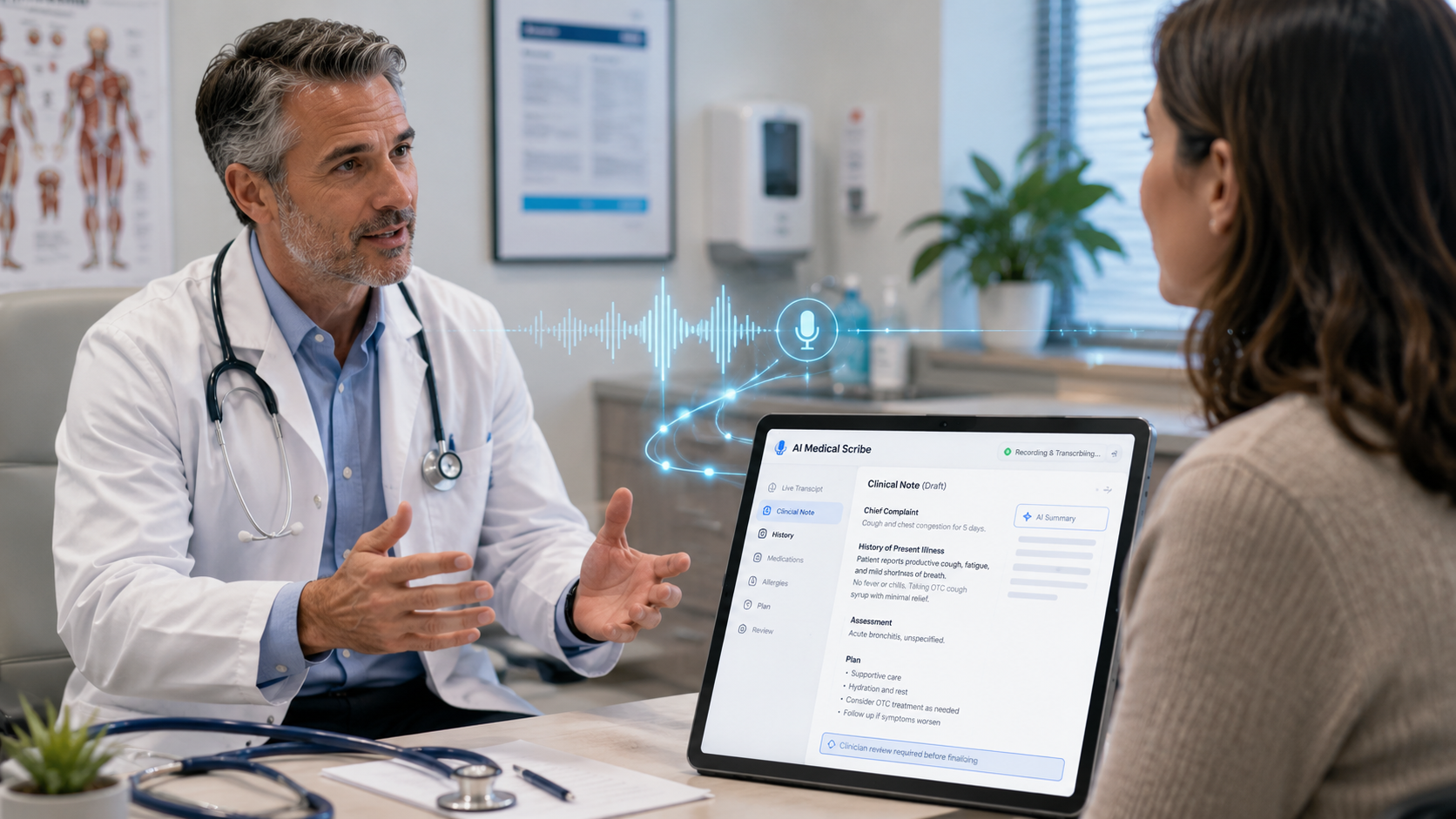
AI Medical Scribes: How Ambient AI Works, Benefits, Risks and Privacy in 2026
AI medical scribes can listen during clinical consultations and turn conversations into draft medical notes, letters and other documentation. This guide explains how ambient AI scr...

FDA AI-Enabled Medical Devices: 2026 List, Uses and Regulation
The FDA maintains a growing list of artificial intelligence-enabled medical devices authorized for marketing in the United States. This guide explains what the FDA list means, the...

Generative AI in Healthcare: Uses, Risks and Regulation in 2026
Generative AI is moving into clinical documentation, patient communication, medical research and decision-support workflows. This guide explains how it is being used in healthcare,...

AI in Healthcare: Uses, Benefits, Risks and Patient Questions (2026)
Artificial intelligence supports medical imaging, documentation, monitoring, research and hospital operations. This evidence-based 2026 guide explains its uses, potential benefits,...

AI in Medical Imaging: What Patients and Clinicians Should Know
Learn how artificial intelligence supports X-rays, CT, MRI, ultrasound and cancer screening, including its potential benefits, limitations, safety risks and FDA oversight.
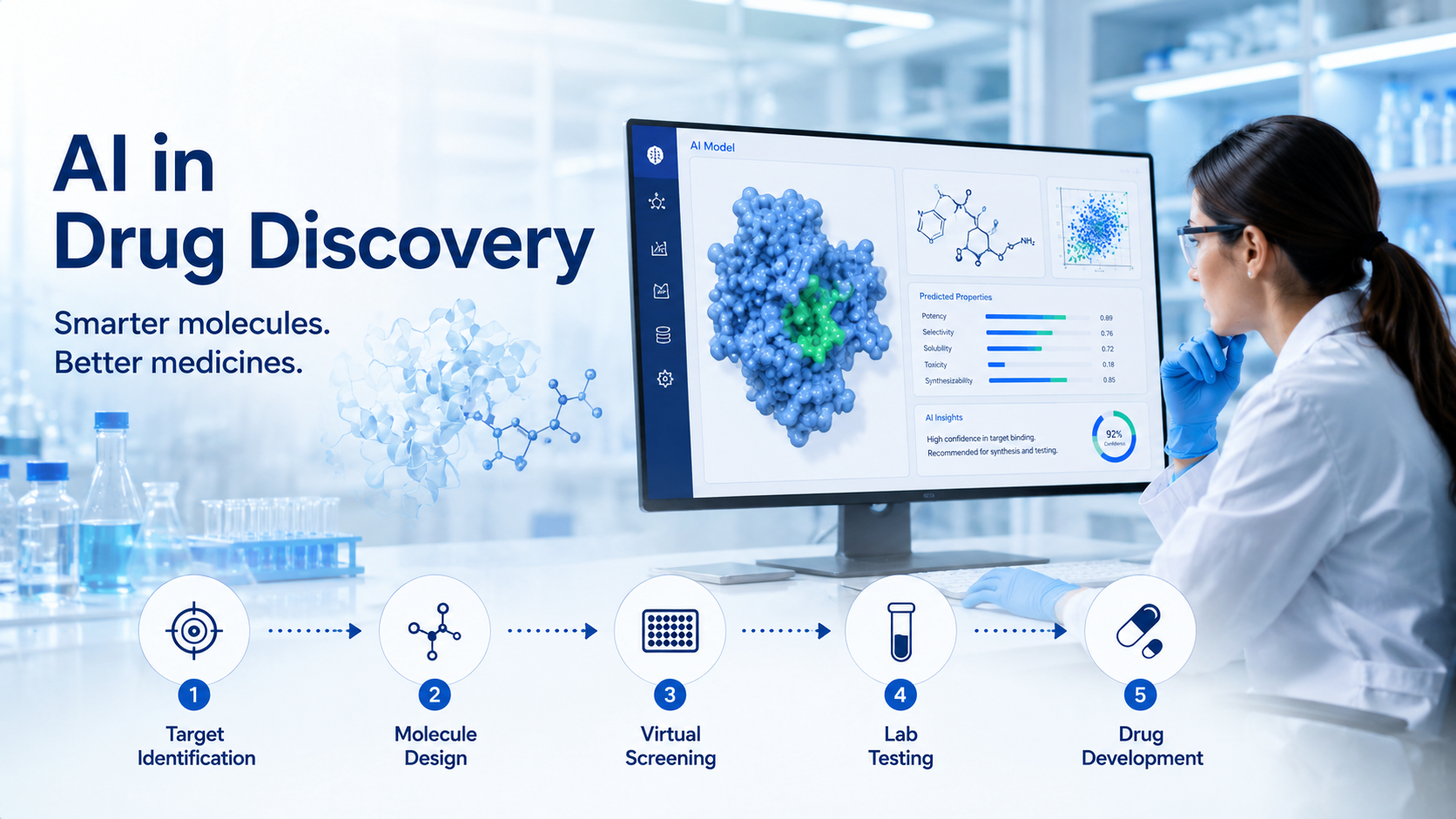
AI in Drug Discovery: How Artificial Intelligence Is Changing Drug Development in 2026
Artificial intelligence is being used to identify drug targets, screen compounds, design new molecules, predict toxicity and support clinical development. This guide explains how A...
Questions & Reader Feedback
Help improve this Atlas article
Ask a general question, comment on the article, suggest a correction, or propose a new topic. Nothing is published automatically. Every submission is reviewed by the Atlas editorial team first.
Was this article helpful?
0 helpful · 0 needs improvement